
How Exchanges Really Make Money (Part 1)

Before anyone attacks the numbers, the "99%" figure is intentionally exaggerated to illustrate a trend rather than represent an audited industry statistic.
However, after spending years in Web3, it often feels like an overwhelming majority of token projects eventually disappear, become inactive, or fail to establish a sustainable business model.
Many projects launch with a token, a roadmap, and a vision for the future. Yet a few years later, their communities have vanished, development has slowed, and the business model remains unclear.
What I find more interesting is that many exchanges—some of which most people have never even heard of—continue operating quietly year after year.
Why is that?
Answers : Revenue !

Most people know exchanges make money from trading fees.
That's true.
But that statement is a bit like saying:
"Restaurants make money from selling food."
Technically correct.
Yet it completely misses the scale, economics, and mechanics behind the business.
For a typical centralized exchange (CEX) or modern CLOB-based decentralized exchange (DEX), the primary revenue sources usually come from:
- Spot Trading Fees
- Perpetual Futures Trading Fees
- Listing Fees
- Market Making Partnerships
- Institutional Services
- API & Infrastructure Services (in some cases)
For traditional AMM-based DEXs, the model often revolves around:
- Swap Fees
- Liquidity Incentive Structures
- B2B Integrations
- Protocol Partnerships
Most people read the list above and think they understand exchange economics.
In reality, they usually understand less than 1% of what makes an exchange valuable.
The real question isn't:
"Where does the revenue come from?"
The real question is:
"How large can that revenue become?"
That is where exchange businesses become incredibly interesting.
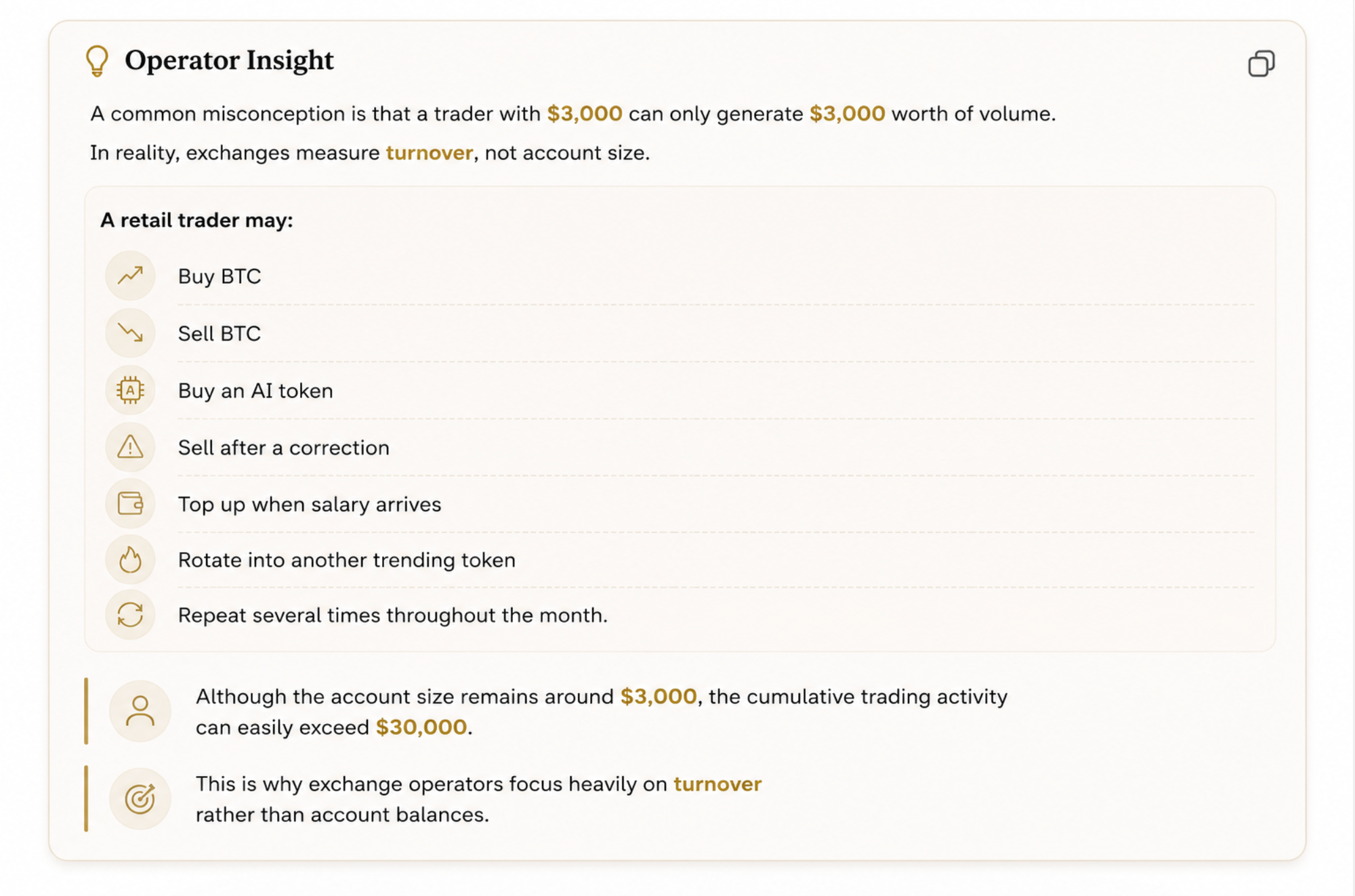
1. Casual Retail Traders
Retail Trader Economics
1 Active Retail Trader
Capital
$3,000
↓
Monthly Volume
≈ $30,000
(10x Turnover)
↓
Exchange Fee
0.05%
↓
Revenue Generated
≈ $15 / Month
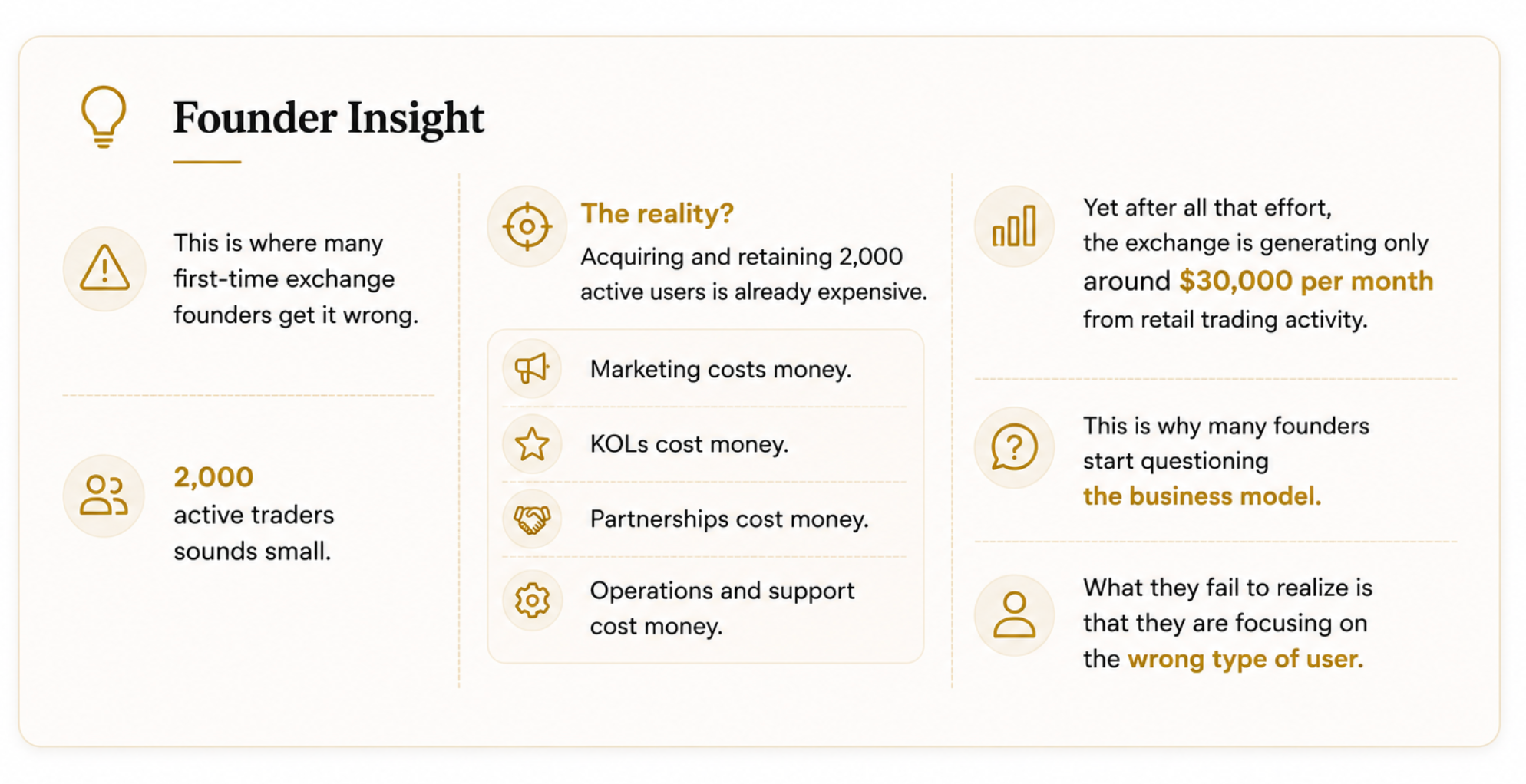
Now let's imagine a small exchange with:
2,000 active retail traders.
Monthly Trading Volume:
2,000 users × $30,000 volume
= $60,000,000
($60M Monthly Volume)
Exchange Revenue:
$60,000,000 × 0.05%
= $30,000 per month
or
$360,000 per year
generated purely from retail trading activity.
At first glance, this sounds quite attractive~
A small exchange~
2,000 active users~
$360,000 annual revenue.~
Not bad.~
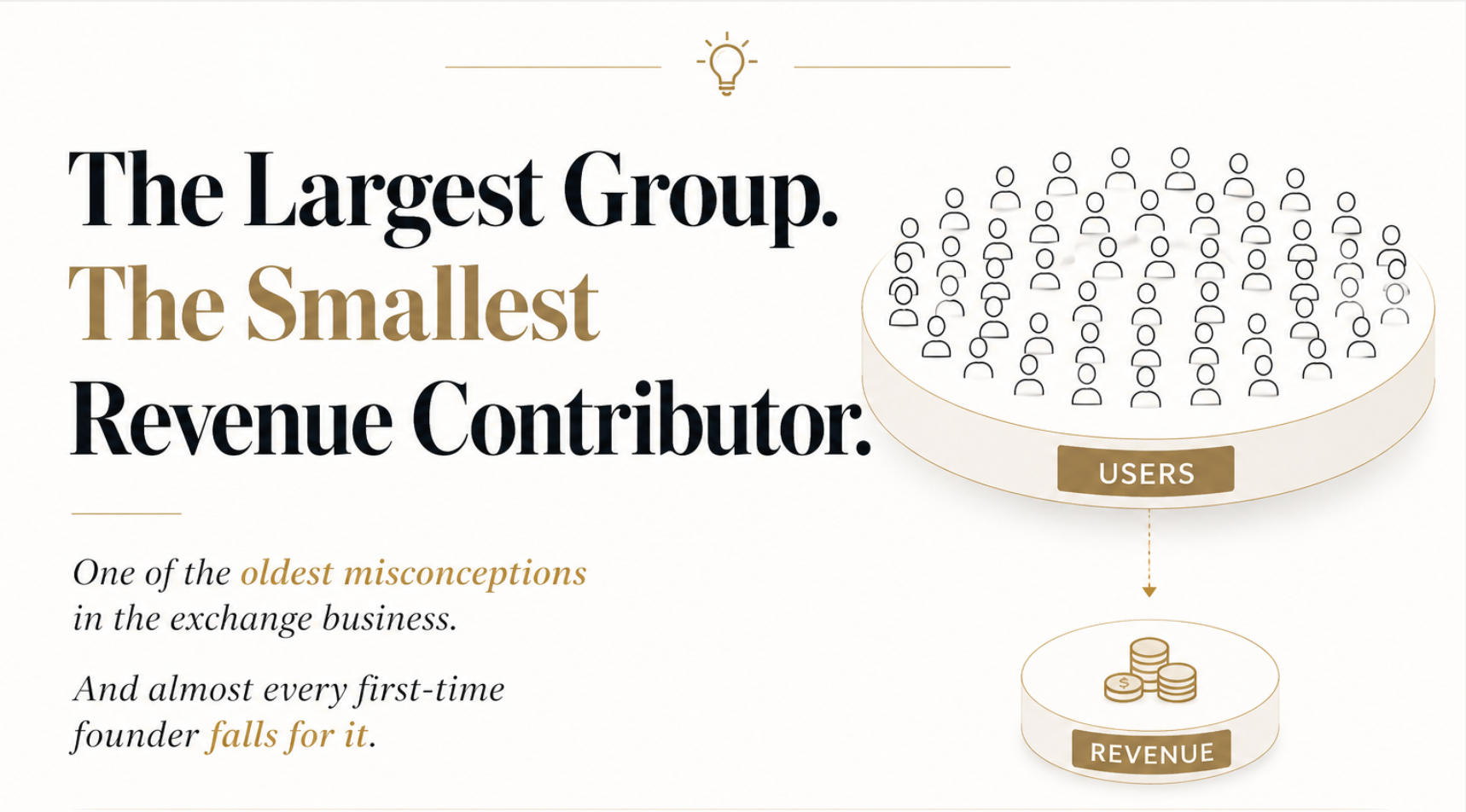
However, this is where many first-time exchange founders make a critical mistake.
Retail traders are important.
They form the foundation of every exchange ecosystem.
However, they are usually not the engine that drives the majority of trading volume.
💡
Everybody Sees The Users.
Almost Nobody Sees The Volume Behind Them.
To understand why exchanges become highly valuable businesses, we need to look deeper.
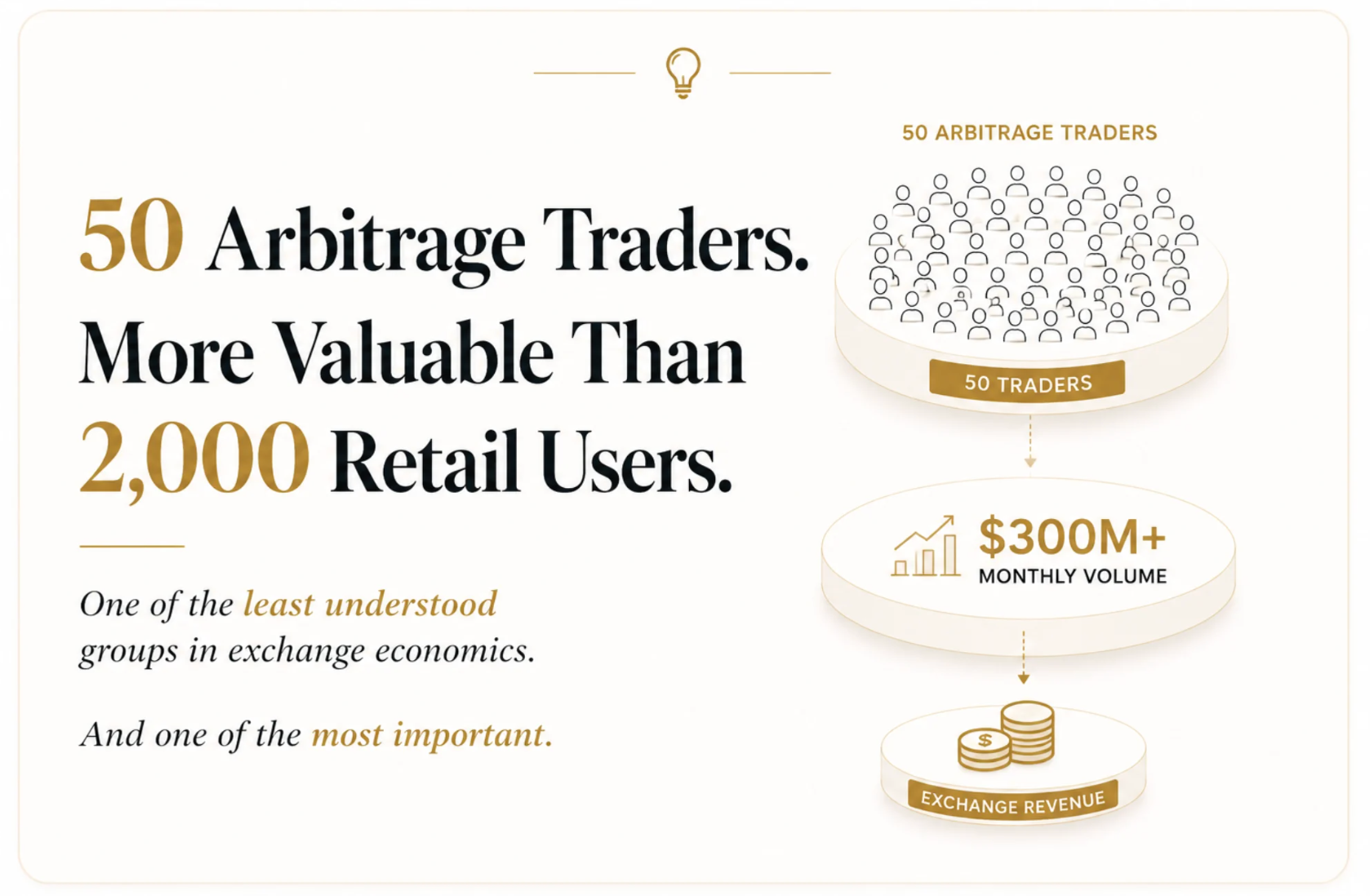
Arbitrage Trader Economics
1 Active Arbitrage Trader
$20,000 Capital
↓
≈ $200,000 Daily Trading Volume
(10x Daily Turnover)
↓
≈ $6,000,000 Monthly Volume
↓
0.05% Trading Fee
↓
≈ $3,000 Monthly Revenue
Generated For The Exchange
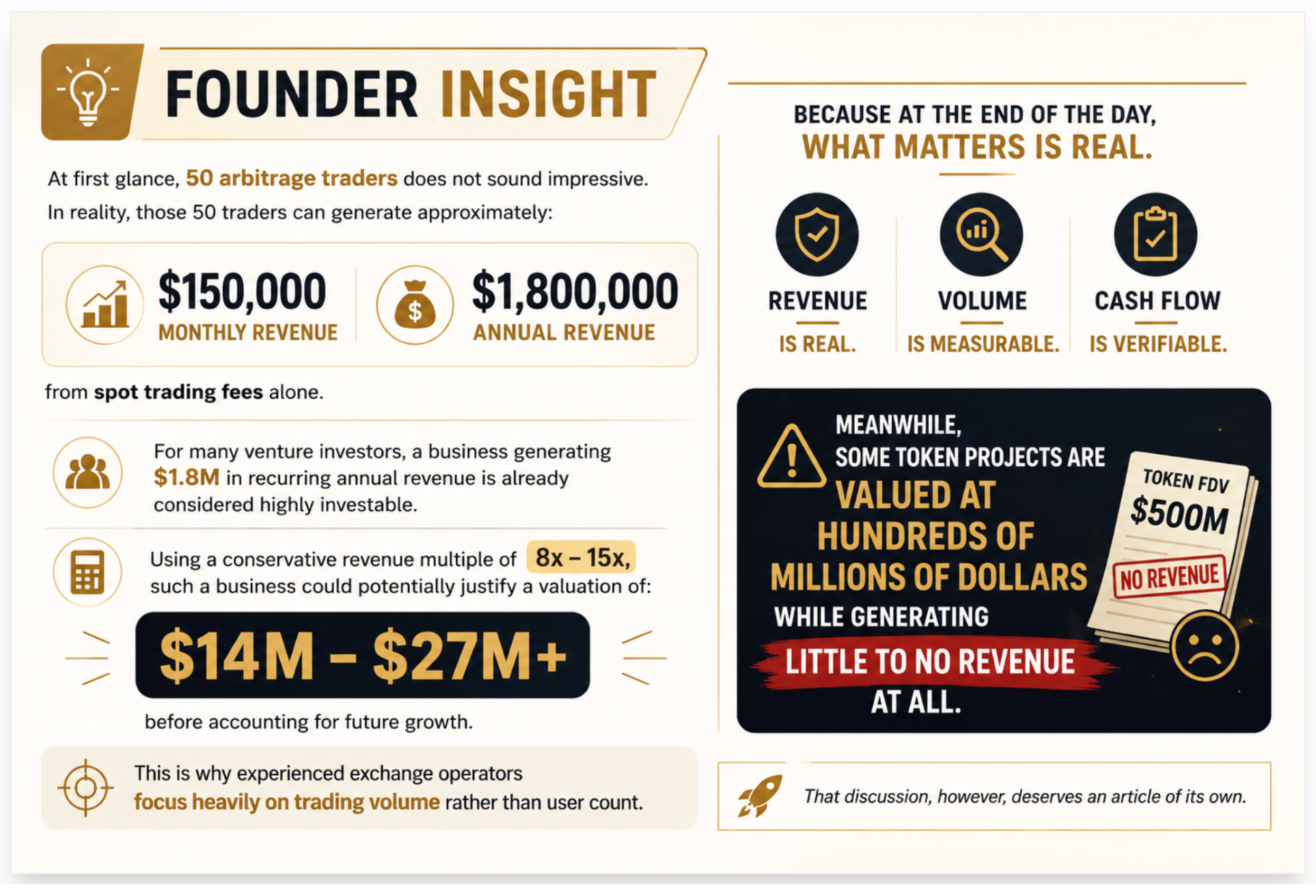
Now let's imagine a small exchange with just 50 active arbitrage traders.
50 × $3,000 monthly revenue
≈ $150,000 per month
or
≈ $1,800,000 per year
Final Thoughts
By now, I believe many readers — especially first-time exchange founders and operators — have already experienced a significant shift in perspective.
Most people enter the exchange business thinking that success is primarily about acquiring more users.
What they often discover is that not all users contribute equally to trading volume, revenue, or business value.
A retail trader and an arbitrage trader may both count as "one user" on the dashboard.
Yet their economic impact can be dramatically different.
And the truth is:
We have only scratched the surface.
To avoid overwhelming readers with too much information in a single article, I will stop here and make this Part 1 of the series.
In Part 2, we will continue exploring other participant groups within exchange ecosystems, including:
• Bot Traders
• Market Makers
• Institutional Traders
• High-Frequency Traders (HFT)
• And why a handful of professional traders can sometimes generate more volume than thousands of retail users.
Because in the exchange business, the most valuable users are often the ones nobody sees.
See you in Part 2.
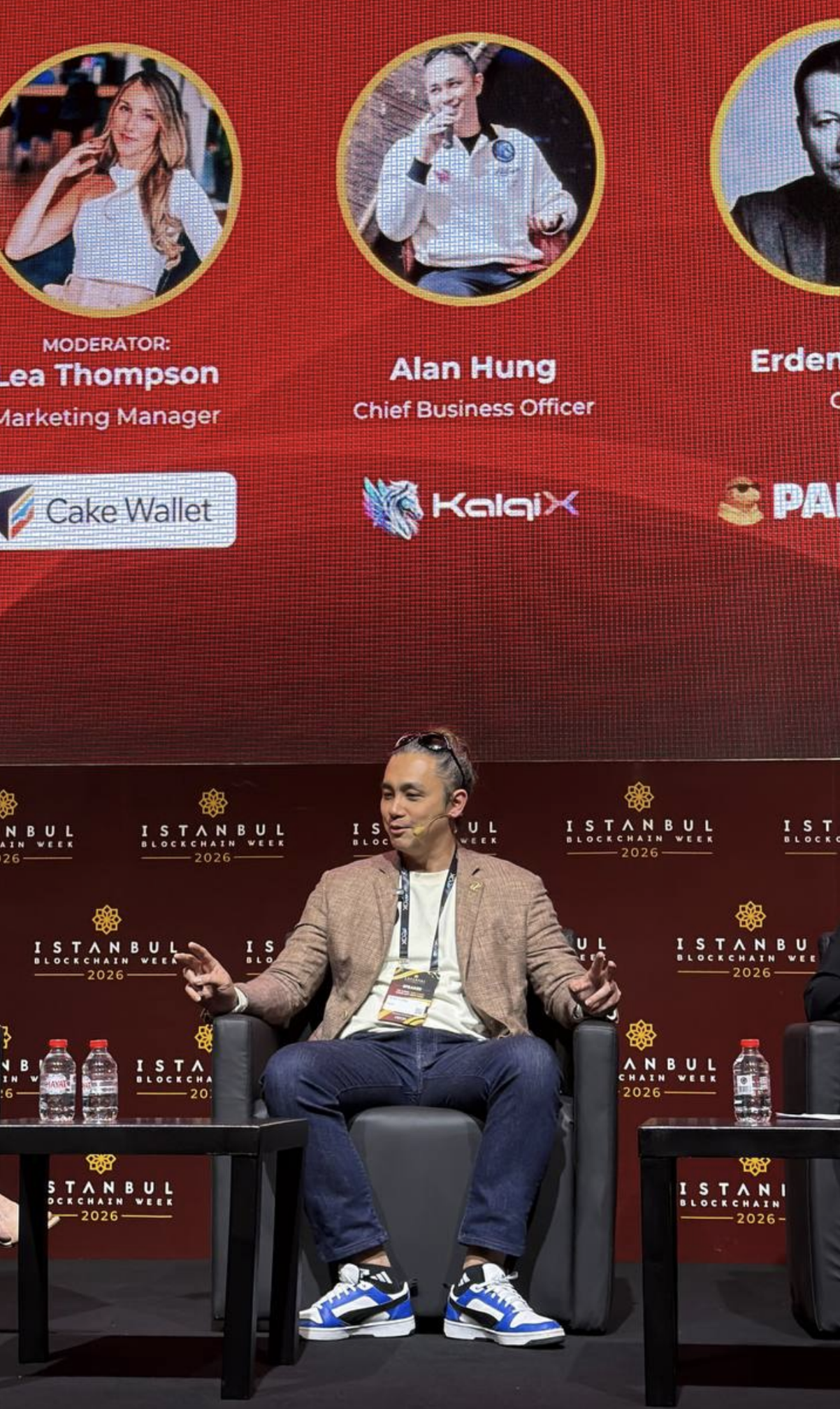
About The Author
Alan Hung is a venture builder, exchange operator, and Web3 entrepreneur with over 15 years of experience spanning traditional businesses, media, blockchain, and digital assets.
Over the past decades , he has worked directly with exchanges, market makers, traders, ecosystem partners, and venture-backed blockchain projects, gaining hands-on experience in exchange growth, trading infrastructure, token economics, and venture development.
Throughout his exchange career, Alan has generated and managed billions of dollars in trading volume across both centralized and decentralized exchanges, including platforms such as Bitunix, Gate.io, CoinW, and EdgeX.
Most recently, Alan generated over $2 billion in trading volume on EdgeX, providing first-hand exposure to the mechanics of exchange liquidity, user behavior, market structure, and trading economics.
He is a Founding Team Member and Chief Business Officer (CBO) of KalqiX, a next-generation ZK3-powered CLOB exchange infrastructure project focused on building the future of high-performance, privacy-preserving, and institution-ready trading infrastructure.
Alan is also the Co-Founder of ZBA Lab, a venture studio focused on incubating next-generation vertical exchanges, digital asset infrastructure, and Web3 ventures, with a primary focus on building white-label CLOB exchanges powered by KalqiX's ZK3 infrastructure.
Through his writing, Alan shares practical operator insights on:
• Exchange Economics
• Trading Volume Mechanics
• Exchange Valuation Models & Revenue-Based Multiples
• Venture Building & Ecosystem Design
• Vertical Niche Positioning in the New Exchange Era
• Market Structure, Liquidity & Trading Infrastructure
• Web3 Business Strategy
Connect With Alan
𝕏 (Twitter)
@Alanhung_zk3
Alan Hung
https://www.linkedin.com/in/alan-hung-4b05293a2/
KalqiX