
The Hidden Cost of MEV: How Much Are DEX Traders Really Losing?

Every time you swap tokens on most DEXs, someone is watching.
Not the protocol. Not the team. Bots.
They see your trade before it settles. They know the token, the size, and your slippage tolerance. And they use that information to extract money from you — every single time they can.
This is MEV. Maximal Extractable Value.
It is the single largest invisible cost in decentralized trading. And most traders have no idea it is happening to them.
What Is MEV?
MEV is the profit that can be extracted by anyone who controls or influences the ordering of transactions in a block.
In practice, this means validators, block builders, and the sophisticated bot networks that pay them for favorable positioning.
The concept is straightforward. If someone can see your trade before it confirms, and rearrange the transaction queue to profit from that knowledge, that profit is MEV.
In traditional finance, this would be called front-running. It is illegal. In DeFi, it is an open, industrialised business.
The Three Types of MEV Attacks
- Front-Running
You submit a buy order. A bot sees it in the mempool. The bot submits the same buy with a higher gas fee so it confirms first. The price moves up. Your order fills at the inflated price.
You paid more than you should have. The bot captured the difference.
This is the simplest form of MEV. The bot races ahead of you by outbidding your gas fee. During volatile markets, gas wars between competing front-running bots get intense. You always pay the inflated price.
- Sandwich Attacks
This is the most common and most damaging form of MEV for retail traders.
It works in three steps.
Step 1: A bot detects your pending swap in the mempool. It sees the token, the amount, and your slippage tolerance.
Step 2: The bot places a buy order immediately before yours, pushing the price up.
Step 3: Your trade executes at this higher price. The bot then sells immediately after your trade, pocketing the price difference as risk-free profit.
Your trade gets sandwiched. You get a worse price. The bot makes money. And you probably never noticed — it just looked like normal slippage.
The damage scales with trade size. A $500 swap might lose a few dollars. A $50,000 swap can lose hundreds or thousands. Institutional-sized orders can lose five or six figures on a single sandwiched transaction.
- Back-Running
After a large trade moves the price on one venue, back-running bots immediately arbitrage the price difference across other venues. While less directly harmful to the original trader than sandwiching, back-running is part of the broader MEV ecosystem that makes on-chain trading more expensive for everyone.
How Much Is MEV Actually Costing Traders?
The numbers are staggering.
Cumulative MEV extracted on Ethereum alone has exceeded $600 million in tracked, on-chain profit. That is the conservative lower bound - it only counts what is visible through public tools like Flashbots and EigenPhi.
The real number is significantly higher when you factor in cross-domain MEV across multiple DEXs and chains, private mempool arrangements that are not publicly tracked, and the indirect costs from price distortion caused by MEV activity.
An estimated $1.2 billion is extracted from DeFi users annually across all networks. During peak activity - market crashes, major token launches, airdrop claims - extraction rates spike dramatically. Individual traders have documented losing thousands of dollars on single transactions during these events.
But here is the part that most people miss. Most MEV extraction does not happen during dramatic market events. It happens on ordinary trades during ordinary market conditions. Every swap you make on a public mempool DEX has some probability of being sandwiched. The cost on any single trade might be small. Over months of active trading, it compounds into a serious drag on performance.
Why the Common Fixes Do Not Actually Work
"Just lower your slippage tolerance"
This is the most common advice. The logic: if you allow only 0.5% slippage instead of 3%, there is less room for bots to profit.
It helps marginally. But tight slippage means more failed transactions during volatile markets. Failed transactions still cost gas. And sophisticated bots can still profit on tight settings — they just work with smaller margins and higher volume.
"Use a private RPC"
Services like Flashbots Protect bypass the public mempool by sending your transaction directly to a block builder. Your trade is not visible to all mempool scanners.
This is a meaningful improvement. But the block builder still sees your transaction. You have moved from being exploited by anyone to being exploited only by the builder. Better, but not solved.
"Use a DEX aggregator with MEV protection"
Some aggregators route through private channels or use batch auctions. These reduce exposure. But they add latency, don't work for limit orders, and still depend on trusted intermediaries in the routing chain.
"Split large trades"
Breaking a $50K swap into smaller pieces reduces the profitability of any single sandwich. But it increases gas costs, adds execution risk from price movement between trades, and is operationally annoying.
Every one of these is a band-aid. They reduce the symptom without fixing the cause.
The Root Cause: Visible Intent
Every MEV attack depends on one thing.
The attacker can see your trade before it executes.
They know what you are buying. They know how much. They know your slippage tolerance. With that information, the attack is mechanical and risk-free.
Private RPCs hide your intent from some observers. Better slippage settings limit profitability. Aggregators add routing layers. But as long as your order details are visible to anyone at any point before settlement — the mempool, the sequencer, the block builder, the relayer — the MEV vector exists.
The only way to truly eliminate MEV is to eliminate the visibility of your order.
The Architectural Fix: How Private Execution Kills MEV
This is where exchange design matters more than any user-side workaround.
A platform that genuinely solves MEV needs to prevent order details from ever being publicly visible at any point in the execution pipeline. Here is what that architecture looks like.
Private order submission. Your signed order goes directly to a matching engine. Not to a public mempool. Not to a shared sequencer. Not to a block builder. Directly to the matcher. Nobody else sees it.
Off-chain matching. The engine matches your order with counterparties in milliseconds. The matching is deterministic and follows price-time priority rules. There is no broadcast of pending orders, no queue that bots can inspect, and no window to insert transactions.
ZK-proven settlement. After matching, a zero-knowledge proof verifies that every match was executed correctly — right prices, right priority, correct settlement amounts. This proof goes on-chain. A smart contract verifies it. The blockchain confirms the batch was computed correctly without ever seeing individual order details.
The result: nobody can see your order intent. Nobody can front-run it. Nobody can sandwich it. The information that MEV bots depend on simply does not exist in the system.
This is not a filter or a shield. It is the removal of the attack surface entirely.
KalqiX's Approach to MEV
At KalqiX, we did not build MEV protection as a feature. We designed an architecture where MEV cannot exist.
Zero mempool exposure. Orders are signed by your wallet and sent directly to our matching engine. They never enter any public or semi-public transaction queue.
Sub-10ms matching. Our Rust-based engine matches orders in under 10 milliseconds. Even if someone could see orders — which they cannot — there is no time window to insert a transaction.
ZK-proof verification. Every batch of matched trades is verified by a zero-knowledge proof on-chain. The chain confirms correctness without revealing what was traded, by whom, or at what size.
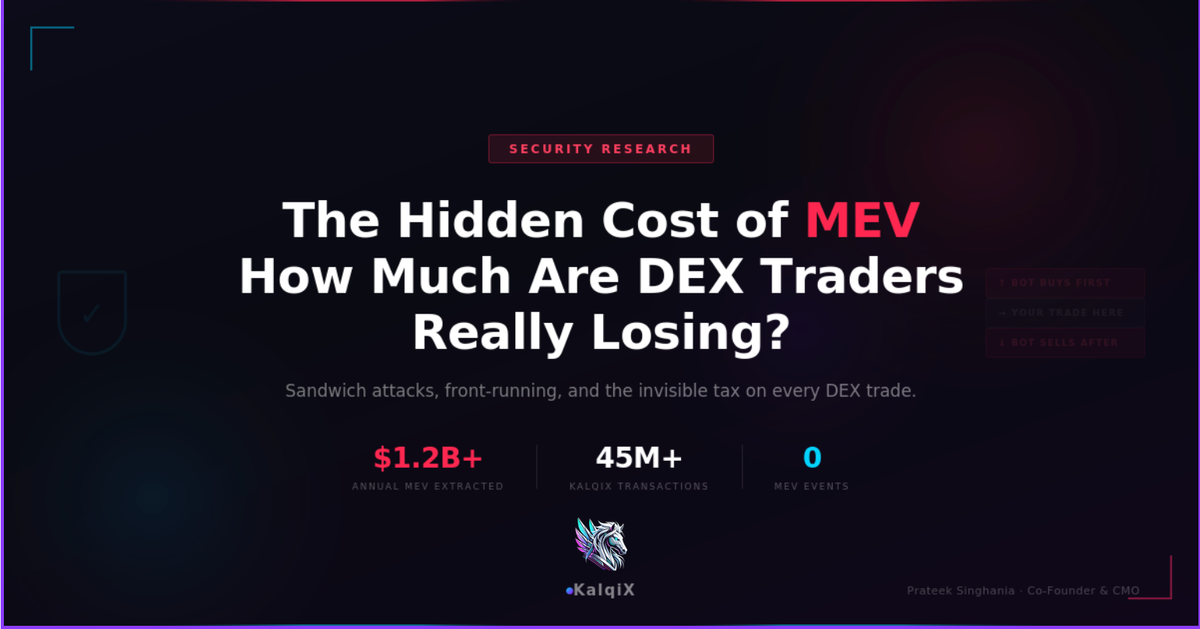
The testnet result: zero MEV events across 45 million+ transactions. Not reduced. Not mitigated. Zero.
This is what structurally eliminating MEV looks like. Not filtering attacks after they happen. Removing the conditions that make them possible.
What You Can Do Right Now
If you are not ready to switch platforms, here are the most effective steps to reduce MEV on existing DEXs, ranked by impact.
- Use Flashbots Protect or MEV Blocker. Add https://rpc.flashbots.net as a custom RPC in your wallet. This routes transactions through a private channel instead of the public mempool. It is free and takes two minutes to set up.
- Use DEX aggregators with private routing. CoW Protocol uses batch auctions that provide meaningful MEV protection for swaps. 1inch Fusion routes through a solver network. Both are better than direct AMM swaps.
- Avoid trading during extreme volatility. MEV extraction is most profitable during market crashes, token launches, and major news events. If you can wait for calmer conditions, you will pay less in hidden MEV costs.
- Set slippage tolerance to 0.5-1% for volatile tokens. This does not eliminate sandwiching but reduces the profit margin for bots. For stablecoin swaps, 0.1-0.3% is usually safe.
- Never use default slippage settings. Most DEX interfaces default to 2-3% slippage. This is an open invitation for sandwich bots. Always set it manually.
- Consider platforms where MEV is architecturally impossible. ZK-powered CLOB DEXs like KalqiX remove the MEV vector entirely through private order flow and zero-knowledge settlement. As these platforms gain liquidity, they represent the cleanest long-term solution.
The Bigger Picture
MEV is not going away on AMM-based DEXs. It is structural. As long as trade intent is visible and transaction ordering is controllable, value extraction will continue. The MEV ecosystem is now a sophisticated industry — dedicated searcher firms, block builder networks, relay systems, and cross-domain arbitrage operations all competing to extract as much as possible.
The total value lost to MEV across DeFi's history is measured in billions. It falls disproportionately on retail traders who do not have the tools or knowledge to protect themselves.
The solution is not better filters or cleverer workarounds. It is moving to execution architectures where MEV cannot exist in the first place. Private order flow, off-chain matching, and zero-knowledge settlement are not experimental concepts. They work today. They are provably effective.
Every dollar lost to MEV is a dollar that should have stayed in a trader's pocket. The infrastructure to prevent that loss now exists. The question is how long traders will keep paying the MEV tax when they do not have to.
KalqiX eliminates MEV by design. Private order matching, sub-10ms execution, and ZK-proof settlement mean bots never see your trades. Zero MEV events across 45M+ testnet transactions. Try the testnet →