
The AscendEX Collapse and Why Kalqix Users Can Always Withdraw

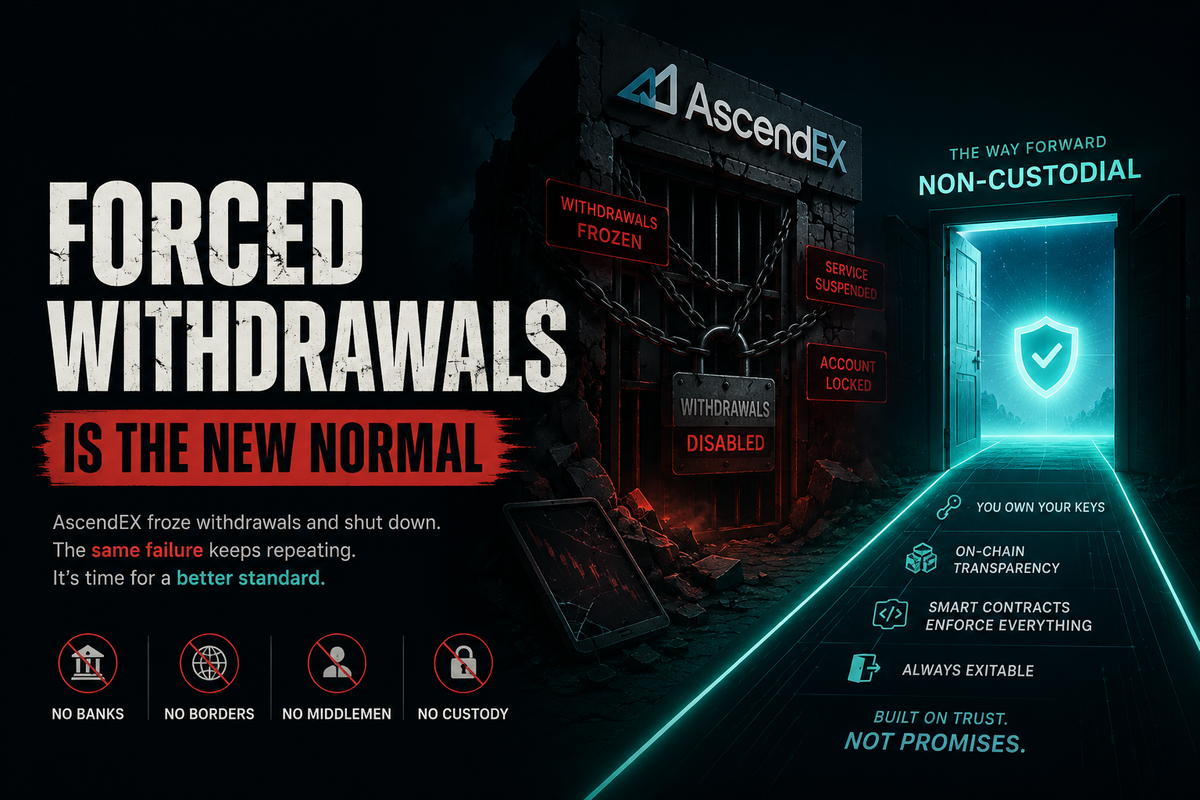
What a failed exchange tells us about the one flaw every custodial platform shares, and the fix that already exists.
There is a sentence buried in AscendEX's shutdown notice that should stop every crypto holder cold. The exchange told its users it "cannot guarantee that customers will be able to withdraw all of the digital assets held in their accounts."
Read that again. Not some assets. Not during a delay. All of them, with no guarantee. This is a licensed exchange that held people's money, and its parting message was that the money might simply not be there.
It's tempting to file AscendEX away as one more bad actor in an industry that has no shortage of them. That would be a mistake. AscendEX is not an aberration. It is the custodial exchange model performing exactly as designed, right up to the moment it fails. Understanding what is the difference between watching this happen again next year and never being exposed to it in the first place.
What actually happened
AscendEX, founded in 2018 as BitMax by a group of former Wall Street quants, ceased operations on July 1, 2026, and confirmed it in a letter to users on July 6. The official explanation was a blend of the corporate and the vague: a "strategic transaction" meant to inject liquidity fell through when the counterparty didn't perform, broader market conditions added pressure, and the exchange lacked the licensing it needed to keep operating in the EU as MiCA came into full effect.
The on-chain record tells a sharper story. In late June, the independent blockchain investigator ZachXBT reviewed AscendEX's publicly labeled hot wallets and found them nearly empty of the assets you'd expect an exchange to be holding: no meaningful ETH, USDT, USDC, or SOL. His conclusion was blunt: no one should be depositing funds to this exchange. Around the same time, roughly $240 million in reserves drained out, unwinding a liquidity injection of similar size from just weeks earlier. And in the days before the shutdown, deposits stayed open while withdrawals were quietly frozen. Users could still put money in, but they couldn't take it out.
By the end, wallets tied to the exchange held only around $13.5 million, and more than $12 million of that sat in illiquid tokens, largely AscendEX's own ASD token alongside UNITE, with little real liquidity to pay anyone back. Withdrawals, where they function at all, now run through "manual review," subject to KYC, AML, and reconciliation checks, with no promise of timing, amounts, or outcome.
Regulators noticed. On July 8, the European Securities and Markets Authority launched its first supervisory sweep of licensed crypto firms, examining exactly the things AscendEX appears to have failed at: key and storage management, transaction controls, and custody risk. AscendEX has become Europe's first real test of whether the new rules can prevent this, or only document it after the fact.
Why this wasn't bad luck
Here is the part that matters, and the part most coverage skips: nothing about this required fraud, a hack, or extraordinary incompetence. The failure is structural.
When you deposit crypto to a custodial exchange, you are not storing your coins there the way you'd store cash in a safe deposit box. You are handing your assets to a company, which now owns them and owes you an IOU. Your balance on the screen is a promise, not property. The exchange controls the private keys. It decides whether your withdrawal goes through. It can lend your assets, trade against them, pledge them to a "strategic counterparty," or simply lose them, and the first you'll hear of it is when the withdrawal button stops working.
As long as everything runs smoothly, the IOU feels like the real thing. The gap only reveals itself under stress. And when it does, the holder discovers they were never a depositor with a claim on their own coins. They were an unsecured creditor of a private company, standing in line behind everyone else the company owes.
That is why "no assurance on user payouts" is not a shocking failure of AscendEX specifically. It is the honest description of what every custodial arrangement actually is, said out loud.
We have seen this exact movie before
Mt. Gox. QuadrigaCX. Celsius. Voyager. FTX. And now AscendEX, an exchange that, worth remembering, had already lost $77.7 million to a hack back in 2021. Different names, different years, different excuses. The mechanism underneath is identical every time: a third party holds the keys, users can't exit without that party's permission, and when the party fails, the permission is revoked overnight.
The industry's standard responses to this pattern have not fixed it. "Proof of reserves" is a snapshot that can be gamed, staged with borrowed funds, or rendered meaningless by liabilities it doesn't show. And it says nothing about the moment reserves quietly walk out the door, as they did here. Licensing helps, and regimes like MiCA raise the floor, but regulation is inherently reactive: it can punish a collapse and compensate some victims, but it cannot un-freeze an account or reverse a transfer that already happened. It leaves the underlying model completely intact: the operator holds your money and grants you access.
You cannot regulate your way out of a design flaw. You have to remove it.
The fix is not a promise. It's an architecture.
The only durable solution is to stop requiring users to hand over custody in the first place.
In a non-custodial design, your assets never become the exchange's property. They sit in on-chain contracts that you control. Trading, matching, and settlement can still happen with the speed people expect, but the exchange never holds the keys to your funds, which means it never has the power to freeze, lend, or lose them. And critically, withdrawal is not a request the operator approves. It becomes what's known as a forced withdrawal: a right the user can trigger directly on-chain, enforced by code, that executes even if the operator stops cooperating, gets hacked, or disappears entirely. No permission, no "manual review," no assurances required. The exact thing AscendEX users are being denied right now is the one thing a forced withdrawal guarantees.
Sit with what that removes. An operator that can't touch your funds can't drain them. A withdrawal that doesn't need permission can't be paused. A collapse becomes an inconvenience (you move on to another venue) instead of a catastrophe that turns your savings into a bankruptcy claim. The AscendEX failure mode simply cannot occur, because the single point of failure that caused it does not exist.
This is the principle we're building Kalqix on: an exchange where self-custody is forced, on-chain withdrawals aren't a marketing badge bolted onto a custodial core, but the foundation everything else is built around. The measure of a good exchange shouldn't be how much you trust it. It should be how little you have to.
How forced withdrawals work on Kalqix
On Kalqix, this isn't a policy we promise to honor. It's a right enforced by the smart contract that holds your funds.
Your assets live in an on-chain contract, not in a company-controlled wallet. Under normal conditions you trade and withdraw through the Kalqix interface, the same smooth experience you'd expect from any exchange. But that interface is only a convenience layer sitting on top. The authority to move your funds lives in the contract, and the contract answers to you, not to us.
So if Kalqix ever shuts the system down, goes offline, is compromised, or simply disappears, you do not have to wait for us, ask us, or trust us to get your money back. You call the withdrawal function on the contract directly, on-chain, and it releases your assets to your wallet. No Kalqix server has to be running. No employee has to approve anything. No "manual review" stands between you and your balance. The code executes, and the funds are yours.
Put plainly: the day Kalqix disappears is still a day our users can withdraw every asset they hold. That is the whole difference between an exchange you have to trust and one you don't.
The lesson AscendEX's users paid for
Every holder locked out of their AscendEX account right now is paying tuition on a lesson the whole industry keeps refusing to learn: if someone else can stop you from withdrawing your own money, it was never fully yours.
The technology to make that impossible already exists. The only question is how many more collapses it takes before "not your keys, not your coins" stops being a slogan people repeat after the fact, and starts being the default people demand before they deposit.
Self-custody isn't a feature. It's the entire point.
Reporting on the AscendEX shutdown drawn from The Block, Protos, and crypto.news, with on-chain analysis by ZachXBT and regulatory context from ESMA's July 2026 supervisory sweep. Nothing here is financial advice.