DeFi
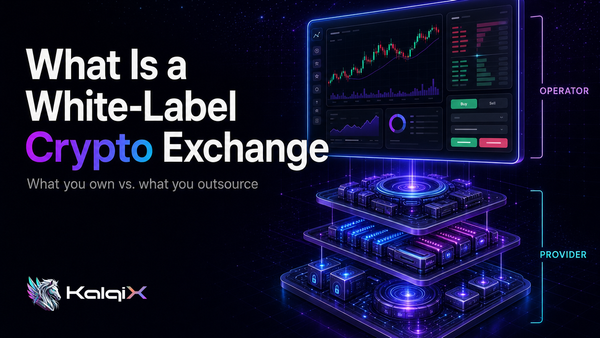
What Is a White-Label Crypto Exchange? What You Own and Outsource
Your brand can sit on someone else’s exchange infrastructure. Here is what that actually means for your product, your users’ funds, your liquidity and your business.

Chief Executive Officer

DeFi
Your brand can sit on someone else’s exchange infrastructure. Here is what that actually means for your product, your users’ funds, your liquidity and your business.

A look at how the QuickSwap integration works, why it took no rebuild, and what it means for every DEX that wants real order book execution without becoming an exchange. Every DEX team eventually hits the same wall. AMM pricing is excellent for liquidity. It is not built for execution.

What a failed exchange tells us about the one flaw every custodial platform shares, and the fix that already exists. There is a sentence buried in AscendEX's shutdown notice that should stop every crypto holder cold. The exchange told its users it "cannot guarantee that customers will

Today, we are live. KalqiX mainnet is officially deployed on Base. Starting now, anyone can connect a wallet, deposit funds, and trade on the first ZK-powered CLOB exchange infrastructure layer in production. This is the moment our team has been building toward for two years. And this post is my

Decentralized exchange infrastructure is going through its biggest architectural shift since AMMs replaced early on-chain order books in 2020. The shift has a name: ZK CLOB DEX. That stands for Zero-Knowledge Central Limit Order Book Decentralized Exchange. It combines the order matching precision of traditional finance with the self-custody of

I spent years building QuickSwap. We grew it from nothing into Polygon's largest native DEX, processing nearly $200 billion in lifetime trading volume and crossing $1 billion in peak TVL. I watched DeFi evolve from a niche experiment into a global financial layer. And I watched it hit

ZK3
New infrastructure doesn’t win because it’s better. It wins because it’s adopted. Over the last decade, crypto has produced no shortage of technically superior systems that never reached critical mass—not due to flaws in design, but because adoption was fragmented, slow, and uncoordinated. Zero-knowledge exchange infrastructure

ZK3
Infrastructure doesn’t fail because of bad code. It fails because of bad incentives. Over the last few years, we’ve watched DeFi repeat the same mistakes: • Critical infrastructure owned by single entities • Execution logic hidden behind “trust us” assumptions • Fragmented standards that don’t interoperate • Competitive silos instead of

ZK3
Looking back two years ago, when we first started building ZK3 + CLOB DEX infrastructure from nothing, it’s hard not to feel nostalgic. At that time, there was no certainty. No assurance the market would be ready. No guarantee that ZK + CLOB could be executed reliably at scale. Fast forward

When traders see “Sub-10ms Latency” on the KalqiX website, the first reaction is usually: “How is that even possible on a decentralized…

Step into the Future of Decentralised Trading