
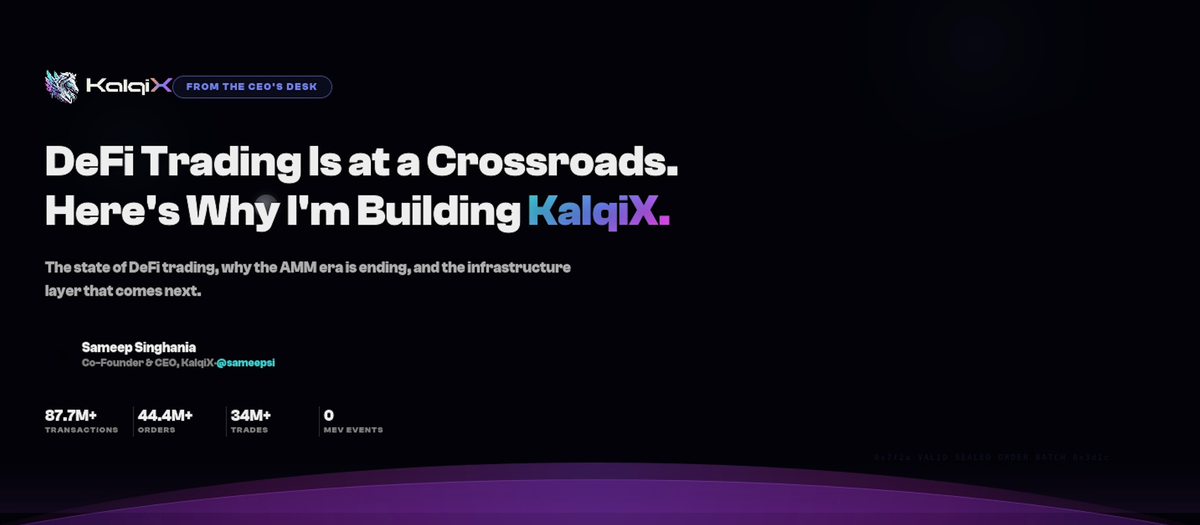
DeFi Trading Is at a Crossroads. Here's Why I'm Building KalqiX.

I spent years building QuickSwap. We grew it from nothing into Polygon's largest native DEX, processing nearly $200 billion in lifetime trading volume and crossing $1 billion in peak TVL. I watched DeFi evolve from a niche experiment into a global financial layer.
And I watched it hit a wall.
Not because the ideas were wrong. The ideas were right. Self-custody, transparency, permissionless access. These are the principles that brought all of us here. But the infrastructure we built to deliver on those principles? It's falling short. And if we're honest about where DeFi trading stands today, the cracks are impossible to ignore.
The Tradeoff That Shouldn't Exist
Here's what I saw firsthand building and running a major DEX.
Centralized exchanges give traders speed, deep liquidity, and a familiar UX. But they take custody of your funds, operate opaque matching engines, and have repeatedly proven they can't be trusted. FTX wasn't an anomaly. It was the predictable outcome of a system where users surrender control for convenience.
On the other side, decentralized exchanges gave traders self-custody and transparency. But AMMs, the model that powered the DEX revolution, come with real costs. Slippage on large orders. Impermanent loss for liquidity providers. And MEV, the invisible tax that bots extract from traders every single day.
In 2025 alone, MEV bots extracted over $900 million from DEX traders. That's not a bug in AMM design. That's the architecture working exactly as built. Public mempools mean visible intent. Visible intent means free money for bots. Better slippage settings don't fix this. The problem is structural.
Traders have been forced to choose: performance or principles. Speed or self-custody. Privacy or decentralization.
I built KalqiX because that tradeoff shouldn't exist anymore. The technology has caught up. And it's time the infrastructure did too.
What Changed: ZK Proofs Grew Up
When we built QuickSwap in 2020, trustless order books at scale weren't feasible. AMMs were the best available answer. They were elegant, simple, and worked well enough for the early days of DeFi.
But it's 2026 now. Zero-knowledge proofs have matured from academic research into production-grade cryptography. What was theoretical five years ago is now deployable.
ZK proofs let you prove that something happened correctly without revealing the details of how it happened. Applied to trading, this means you can verify that every order was matched fairly, every trade was settled correctly, and every execution was free from manipulation, all without exposing the trader's intent to the public.
This is the unlock. This is what makes a trustless central limit order book possible.
KalqiX: Trading Infrastructure, Not Just Another DEX
KalqiX isn't another exchange competing for volume. It's the infrastructure layer that exchanges run on.
At its core, KalqiX is a ZK-powered central limit order book. Orders are submitted off-chain in encrypted form. Our Rust-based matching engine processes them with sub-10 millisecond latency, using price-time priority, the same model used by professional trading venues. Every batch of trades is then converted into a zero-knowledge proof and settled on Base, with data availability on Avail.
No public mempool. No MEV. No custody tradeoff. Every trade is verifiable, private, and self-custodial by default.
Our testnet has processed over 87.7 million transactions, 44.4 million orders, and 34 million trades across more than 6,200 users. Zero MEV events. The architecture works.
But the part I'm most excited about isn't the matching engine itself. It's what it enables.
The White-Label Thesis: Infrastructure That Scales
The future of crypto trading isn't one giant exchange. It's thousands of specialized ones.
DAOs, NFT communities, token projects, trading groups. Each of these communities has unique trading needs. But none of them should have to build matching engine infrastructure from scratch. That's expensive, slow, and fragments liquidity across dozens of competing order books.
KalqiX solves this with its white-label model. Any team can launch a fully branded exchange, their logo, their colors, their community, on top of KalqiX's matching engine and shared liquidity pool. Launch time is under one hour. No infrastructure build required.
Every new front-end that launches on KalqiX adds to the same underlying order book. More exchanges means deeper liquidity for everyone. Instead of competing for the same pool of volume, the entire network compounds.
This is why I call KalqiX an infrastructure layer, not a DEX. We're not trying to win the exchange war. We're building the layer that every exchange runs on.
The Convergence Is Coming
I believe the distinction between centralized and decentralized exchanges will disappear within five to ten years.
Not because one side wins. Because the technology converges. Traders will get CEX-grade speed and UX with full self-custody, privacy, and verifiable execution. They won't know or care whether the backend is "centralized" or "decentralized." They'll just know that their funds are theirs, their trades are fair, and the system works.
KalqiX is the infrastructure that makes that convergence possible.
We're already expanding beyond EVM chains. Our partnership with Citrea, a Bitcoin ZK Rollup, brings KalqiX's trading infrastructure to Bitcoin's security model. The vision was never to be locked into one chain. It was to build execution infrastructure that works everywhere.
What's Next
Testnet is live. Mainnet is imminent.
We're launching with spot trading first. Perpetual futures are coming post-mainnet, with the same privacy and performance backbone. The white-label model is ready for operators who want to launch their own branded exchange on day one.
I started KalqiX because I saw what was broken from the inside. I know what it takes to build a DEX that handles real volume, real users, and real money. And I know that the AMM model, as groundbreaking as it was, is not where DeFi trading ends.
It's where it started. KalqiX is what comes next.
The name KalqiX is inspired by Kalki, the prophesied 11th avatar of Lord Vishnu, the bringer of balance and truth. In the same spirit, KalqiX exists to restore fairness, transparency, and trust to the world of trading.
Performance doesn't have to come at the cost of principles. And proof and privacy can go hand in hand.
See you on mainnet.