
How KalqiX Lets Any DEX Add a Trustless CLOB Without Becoming an Exchange

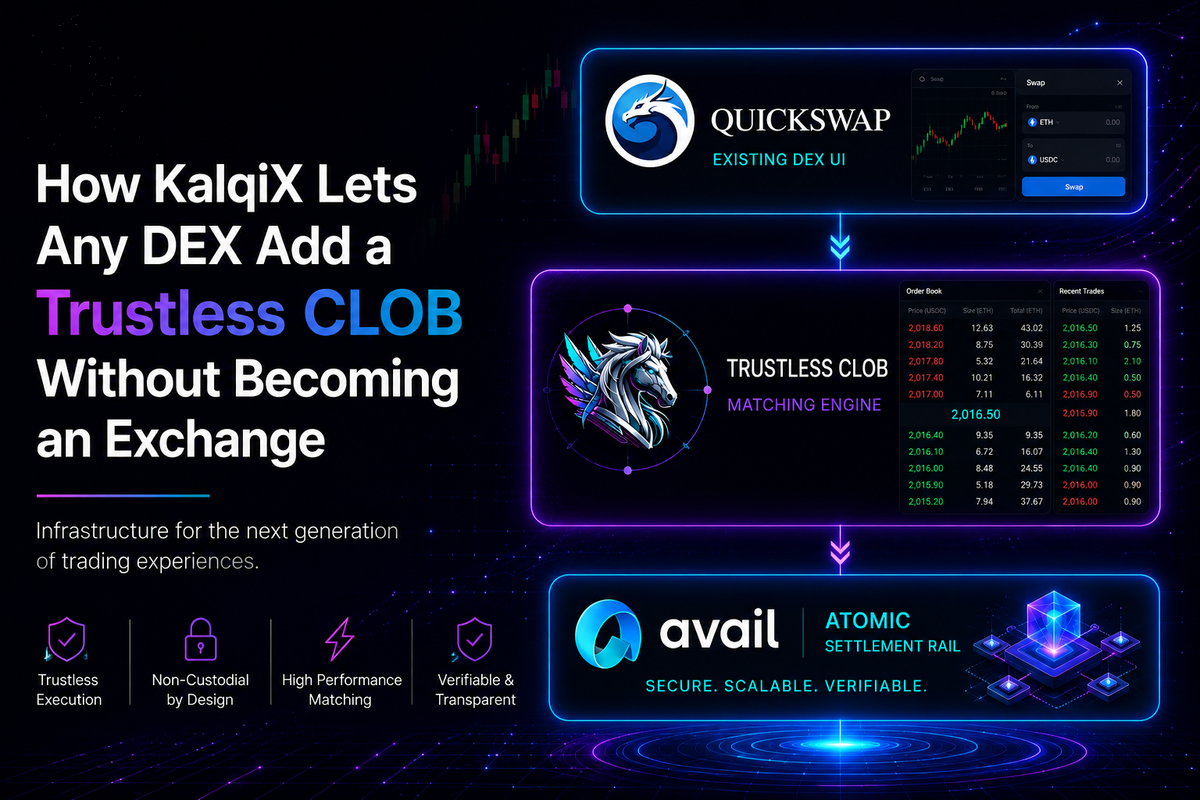
A look at how the QuickSwap integration works, why it took no rebuild, and what it means for every DEX that wants real order book execution without becoming an exchange.
Every DEX team eventually hits the same wall.
AMM pricing is excellent for liquidity. It is not built for execution. A pool prices off a curve, which means slippage on size and no way to place a real limit order. For a serious trader, that is a dealbreaker. The obvious fix is an order book. The reason almost nobody adds one is that they assume it means becoming an exchange: standing up a matching engine, taking custody, owning settlement, and absorbing years of work that has nothing to do with their actual product.
It does not have to mean that. QuickSwap just proved it.
QuickSwap, an established and live AMM that has processed close to $200B+ in lifetime volume, added trustless central limit order book (CLOB) execution to its product suite without rebuilding its stack and without asking its users to change anything. It did this by integrating KalqiX as the execution layer, with orders routed and settled through Avail Atomic. This article walks through how that integration actually works, and why the same path is open to any DEX.
The problem with the two old options
Before this integration pattern existed, a DEX that wanted order book execution had two choices, and both were bad.
The first was to build an exchange from scratch. Matching engine, custody infrastructure, settlement logic, the operational weight of running all of it. That is a multi-year detour from the product your users actually came for, and it turns a DEX into something it never set out to be.
The second was to route to a centralized venue. Faster to ship, but you inherit that venue's trust assumptions. Your users came to a DEX specifically to avoid handing custody and execution to a third party, and routing to a centralized book quietly gives back the thing they were trying to keep.
So the real problem was never "order books are hard." It was that the only ways to get one cost you either years of engineering or the trust guarantees that make a DEX worth using.
The unlock: CLOB execution as infrastructure
The shift that makes the QuickSwap integration possible is treating CLOB execution as an infrastructure layer you plug into, not a product you have to become.
This is what KalqiX is. KalqiX is not a DEX, and it does not compete with QuickSwap or any AMM. It is the trustless CLOB execution layer that DEXs build on. The order book lives at the infrastructure level, provable and non-custodial. A DEX integrates it the way it would integrate any other piece of infrastructure. It does not turn into an exchange to use it.
That single reframing collapses the old tradeoff. You no longer choose between building an exchange and trusting one. You plug into a layer that already solves execution, and you keep being the product you already are.
How the QuickSwap integration actually works
There are three distinct layers in this integration, and they do not overlap.
QuickSwap is the frontend. It is the DEX users already know and trade on. Nothing about that experience changes. Users keep their existing flow, their existing interface, their existing expectations.
KalqiX is the execution layer. When an order needs real order book pricing rather than pool pricing, KalqiX is where that matching happens. The order book is provable and non-custodial, which is what makes the execution trustless rather than just fast.
Avail Atomic is the settlement rail. It routes the order and settles it atomically, so the frontend can reach CLOB pricing without bridging assets or handing off custody. The transaction either completes fully or does not happen at all. There is no in-between state where funds are exposed.
Put together, the flow is simple from the user's side and carefully designed underneath. A QuickSwap user trades the way they always have. Under the hood, their order can reach a real order book through KalqiX and settle atomically through Avail Atomic. No bridge. No new app. No new account. No additional trust assumption introduced anywhere in the path.
That last point is the one that matters most, so it is worth being precise about it.
Why "trustless" is architecture, not a label
It is easy to put the word trustless on a launch graphic. It is harder to make it true at the level where it counts, which is execution.
The reason this integration can be called trustless is that execution provability is built in at the architecture level. This is a structural property, not a feature you bolt on later. You can retrofit governance. You can change parameters, adjust policy, add controls after the fact. You cannot retrofit whether execution was provable in the first place. It is either part of how the system was built or it is not there at all.
With KalqiX, it is part of how the system is built. The order book is provable and non-custodial by design, and Avail Atomic's atomic settlement means a user is never in a position where their assets sit exposed between two steps. The trust you would normally have to extend to a centralized venue simply is not required, because the architecture removes the need for it rather than asking you to believe it is safe.
This is also why the integration is genuinely a drop-in rather than a compromise. The DEX is not trading away its trust guarantees to get better pricing. It is getting both.
Why this matters for any DEX, not just QuickSwap
QuickSwap is the first DEX live on this layer. It is not meant to be the last, and the integration pattern is deliberately general.
The same layer fits a wide range of products. DEXs moving beyond AMMs can add order book execution without a rewrite. Perpetuals and derivatives protocols can use a provable matching layer instead of building one. Lending, yield, and structured product platforms can offer better execution to their users. L1 and L2 chains that want a native CLOB layer can build on the same infrastructure rather than reinventing it.
The common thread is straightforward. If you have users, and you want better execution for them, you no longer have to choose between staying an AMM and becoming an exchange. The layer is open, and the QuickSwap integration is the working proof that plugging into it is a drop-in rather than a detour.
What the integration showed
Strip it back to the core takeaway and it is this.
An existing, live DEX added trustless CLOB execution to its product suite. It did not rebuild its stack. It did not take custody or stand up a matching engine. It did not ask its users to bridge, install, or trust anything new. It integrated KalqiX as the execution layer, settled through Avail Atomic, and kept being QuickSwap the entire time.
That is what "easy" actually means here. Not a marketing word, but a description of how little had to change for how much the users gained: real order book pricing, atomic settlement, and no new trust assumptions.
The choice between AMM and order book is no longer a choice you have to make. And you do not have to become an exchange to offer one.
KalqiX is the trustless CLOB execution layer that DEXs, protocols, and chains build on. To explore an integration, [get in touch] or read more on the [KalqiX blog].