
Multisig Wallets Explained: What Multiple Signers Protect and What They Do Not
A multisig wallet needs several keys to move funds, so one stolen key isn't enough. But multiple signers fail in predictable ways too. Here's how thresholds work, why splitting a seed phrase isn't the same thing, and where multisig still breaks.

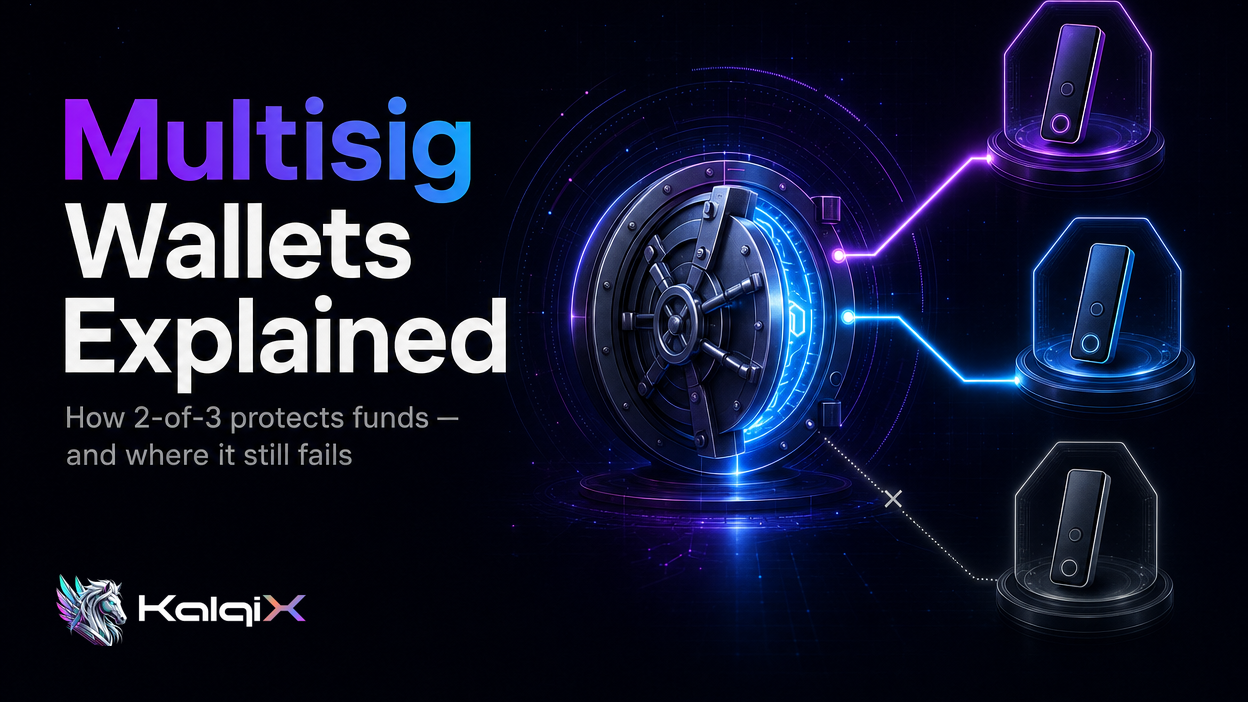
A normal crypto wallet has a single point of failure: one private key. Whoever holds it can move everything, and if you lose it, everything is gone.
A multisig wallet changes that rule. Instead of one key, it needs several keys to approve a transaction. That simple idea protects billions of dollars in DAO treasuries, exchange reserves and personal savings.
It is also widely misunderstood. Some of the largest hacks in crypto history hit multisig wallets, and the signers did exactly what the system asked them to do: they signed.
This guide explains how signing thresholds work, why multisig is not the same as splitting a seed phrase, and what multiple signers do and do not protect. If you're new to the basics of holding your own keys, start with our guide to self-custody trading.
What a Multisig Wallet Is
"Multisig" is short for multi-signature. A multisig wallet is controlled by a set of keys (the signers) and a rule for how many of them must approve before funds can move (the threshold).
The rule is written as M-of-N: M signatures required out of N total signers.
Here's a simple example. You set up a 2-of-3 multisig with three keys:
- A hardware wallet you keep at home.
- A second hardware wallet from a different manufacturer, stored at a relative's house.
- A key held by a trusted friend or a professional key holder.
To send funds, any two of the three must sign. One key alone can do nothing. If a thief steals the hardware wallet from your home, they still need a second key. If you lose that hardware wallet, you can still move funds with the other two.
That's the whole appeal in one example: multisig protects against losing one key and against someone stealing one key, at the same time. A single-key wallet can only ever be optimized for one of those.
On Bitcoin, multisig is built into the protocol's scripting rules. On Ethereum and EVM chains like Base, it's usually a smart contract wallet, with Safe (formerly Gnosis Safe) the best-known example. The contract holds the funds and only executes a transaction once enough owners have signed.
Choosing a Threshold
Different thresholds trade security against convenience and recovery. A quick comparison:
| Setup | Theft of one key | Loss of one key | Typical use |
|---|---|---|---|
| 1-of-2 | Funds at risk | Still accessible | Shared convenience, not security |
| 2-of-2 | Protected | Funds locked | Rarely wise: no room for loss |
| 2-of-3 | Protected | Still accessible | Personal savings, small teams |
| 3-of-5 | Protected (even two keys) | Still accessible (even two keys) | Treasuries, DAOs, companies |
Two patterns stand out.
Thresholds where M equals N are fragile. In a 2-of-2, losing one key locks the funds forever. Nobody can override a smart contract or a Bitcoin script because "you meant well".
Thresholds of 1 are not really multisig. A 1-of-2 just means two separate single points of failure.
The sweet spot for most individuals is 2-of-3. Organizations often use 3-of-5 or 4-of-7, so that several people must collude or be compromised before anything moves.
Multisig Is Not the Same as Splitting a Seed Phrase
A common shortcut is to split a seed phrase: write the first 12 words on one card and the last 12 on another, and store them in different places. It feels like multisig. It isn't.
Here's why:
- It weakens the secret. Each half of a 24-word phrase reveals half of the key. Someone who finds one half has far fewer combinations left to guess.
- It creates a recovery trap. Lose either half and the wallet is gone. You've effectively built a 2-of-2 with worse security.
- The key comes back together. To use the wallet, you reassemble the full seed on one device. At that moment, you're back to a single key on a single machine.
More advanced schemes such as Shamir's Secret Sharing split a secret into shares so that, say, any 3 of 5 can rebuild it. That fixes the first two problems. It doesn't fix the third: the full key is still rebuilt in one place before signing.
True multisig never puts the keys together. Each signer signs separately, on their own device, and the chain or the contract checks that enough valid signatures exist. There is no moment when one compromised machine holds full control.
(MPC wallets are a third approach: key shares sign together through cryptography without ever forming a full key. They can be strong, but the rules live in the provider's software rather than on-chain, so you rely more on that provider.)
What Multisig Protects
Used well, a multisig wallet defends against a specific set of threats:
- A single stolen key. Malware on one laptop, a phished hot wallet or a stolen hardware device isn't enough on its own.
- A single lost key. Fire, flood, a forgotten PIN or a dead device doesn't cost you your funds, as long as you're above the threshold.
- One rogue insider. In a company or DAO, no single employee or member can drain the treasury.
- Physical coercion, partly. If the other signers are in other cities or held by other people, an attacker at your door can't force a transfer on the spot. We covered this threat in crypto home invasions and wallet security.
- Impulsive mistakes. A second signer is a built-in pause before a large transfer.
What Multisig Does Not Protect
This is where most real losses happen. Multiple signers only help if the signers are truly separate and actually understand what they're signing.
Signers that aren't independent
A 5-of-9 multisig where one organization controls five keys is really a single-signer wallet with extra steps.
That's roughly what happened to the Ronin bridge in 2022. Attackers needed 5 of 9 validator signatures. Four keys were run by one company, and a fifth had been delegated to that same company, so compromising one organization was enough. The Harmony Horizon bridge, hacked the same year, was secured by a 2-of-5 multisig: two compromised keys were all it took.
Signers also lose independence quietly when they:
- Use the same wallet brand and the same signing software.
- Sit on the same office network or cloud account.
- Store their seed backups in the same place.
- Answer to the same person who can pressure them all.
Malicious transactions that every signer approves
Multisig counts signatures. It doesn't judge intent. If enough signers approve a harmful transaction, the wallet executes it.
The clearest example is the Bybit hack in February 2025, one of the largest thefts in crypto history at roughly $1.5 billion. Attackers compromised the web interface the signers used, so the screen showed what looked like a routine transfer. Underneath, the transaction changed the wallet's contract logic and handed control to the attackers. The signers did their job. The data they were shown was a lie.
The lesson: a multisig is only as strong as the signers' ability to verify what they sign.
Losing too many keys
Multisig moves the recovery problem, it doesn't remove it. In a 2-of-3, losing two keys locks your funds permanently. There's no support desk for a smart contract.
Approvals and contract risk
A multisig can still grant a token approval to a malicious contract, and once it's granted, the spender doesn't need more signatures. Review old approvals regularly with revoke.cash or your block explorer's approval checker. And smart contract multisigs carry the usual risk that the contract itself has a bug, which is why mature, widely audited contracts are the safer choice.
How to Make Signers Truly Independent
A practical checklist:
- Different devices, ideally hardware wallets from different manufacturers.
- Different locations, so one fire, burglary or border check can't reach a threshold of keys.
- Different people for organizational wallets, with no single person able to direct the others.
- Separate backups for each key, never stored together.
- Independent verification. Each signer checks the transaction on their own hardware wallet screen, and where possible decodes or simulates it with a separate tool, not just the website that proposed it.
- Watch for unusual operations. A transfer should look like a transfer. A transaction that changes owners, the threshold or the contract's code deserves a full stop and a second review.
Plan Recovery Before You Need It
Write down more than just seed phrases:
- The wallet setup itself. For Bitcoin multisig, you need the wallet configuration (the public keys of all signers and the threshold), not only your own seed. Without it, rebuilding the wallet can be very hard.
- The address and chain. For smart contract multisigs, record the wallet address and network.
- Replace lost signers quickly. If one key in a 2-of-3 is lost or exposed, use the remaining two to swap it out right away, before a second failure leaves you stuck.
- Inheritance. Make sure someone you trust knows the wallet exists and how to reach the signers, without holding enough keys to act alone.
Where Multisig Fits for Traders
Multisig is great for long-term holdings and treasuries. It's slow for active trading, because every action needs several approvals.
A common pattern is to keep savings in a multisig and move a working balance to a separate trading wallet. On KalqiX, that trading balance stays in self-custody: funds sit in the KalqiX contract on Base rather than with an operator, withdrawals always go back to your own wallet, and an escape hatch lets you withdraw on-chain even if every other component goes offline. That's a different layer of protection than multisig, and they complement each other. Our post on the AscendEX collapse shows why that withdrawal guarantee matters.
FAQ
Is a multisig wallet safer than a hardware wallet?
They solve different problems, and the best setups combine them. A hardware wallet protects one key from malware; a multisig made of several hardware wallets also protects you against losing or having one of them stolen.
What happens if I lose one key in a multisig?
If you still meet the threshold, nothing is lost: you can sign with the remaining keys and replace the missing signer. If you fall below the threshold, the funds are locked permanently.
Does a multisig cost more to use?
Usually a little. Smart contract multisigs on EVM chains cost gas to deploy and slightly more per transaction, and Bitcoin multisig transactions are larger than single-key ones. For savings that rarely move, the extra cost is small.
Can a multisig be hacked?
Yes, if enough signers are compromised or tricked into signing a malicious transaction. Independent signers and careful transaction checks are what make a multisig hold up in practice.
The Takeaway
A multisig wallet replaces one point of failure with a rule: several independent keys must agree. That protects you against a single theft, a single loss and a single bad actor. It doesn't protect you against signers who share a weakness, or against everyone approving a transaction they didn't understand. Separate your signers, verify what you sign and plan recovery before you need it.
When you're ready to trade with a self-custodied working balance, connect your wallet at app.kalqix.com.