
Community-Owned Crypto Exchanges: The White-Label Business Case for DAOs
A DAO can own its trading experience without building a matching engine. The business case depends on what the community controls, how fee revenue works, and who remains accountable.

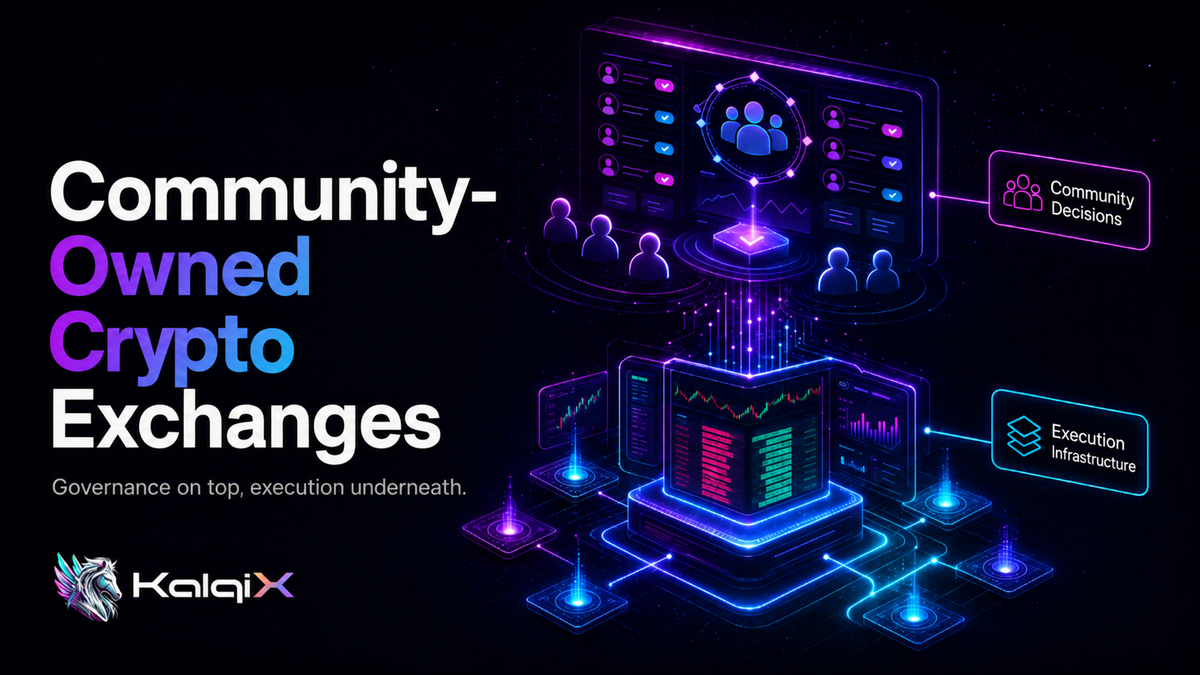
A trading community brings something valuable to an exchange: people who actually want to trade there. Yet the interface, product decisions and trading revenue often belong to someone else.
For a DAO, that raises a reasonable question. If the community already has users, a treasury and a way to make decisions, could it operate its own exchange?
Yes, but “operate” matters more than “own.” A community-owned crypto exchange needs more than a governance vote and a branded trading screen. It needs a useful product, accountable operators and economics that survive after launch incentives end.
This post examines the business case: why a DAO might run an exchange, what responsibilities remain with the community, and how KalqiX provides the execution infrastructure underneath it.
What makes a crypto exchange community-owned?
A community-owned crypto exchange is a trading product whose ownership and meaningful decisions sit with a community rather than a conventional private operator.
That can mean a DAO controls the brand, funds development from its treasury, appoints operating contributors and decides how business revenue is used. It does not necessarily mean token holders vote on every operational decision.
The useful distinction is between ownership, governance and execution.
Ownership concerns who controls the business and benefits from it. Governance concerns how decisions are made. Execution concerns how orders are matched and trades settle.
Those layers do not have to be built or operated by the same people. A DAO can own the customer-facing exchange while using external execution infrastructure, just as a community-owned business can use outside payment processing.
But the label needs substance. If the community cannot influence the budget, appoint accountable operators or oversee revenue, “community-owned” may describe the marketing more accurately than the business.
Why would a DAO run its own exchange?
Fee revenue is one reason. It is not a sufficient reason on its own.
The strongest case starts with a trading need the community understands better than a general-purpose venue.
Keep the product close to its users
A trading group might want a focused interface for its members. A DeFi community might want order-book trading alongside its existing products. A DAO might want a trading experience shaped by community feedback rather than another company's priorities.
An order book lets traders submit buy and sell orders at prices they choose. A matching engine connects compatible orders, rather than pricing every trade against an automated market maker's pool formula.
Owning the frontend gives the community room to decide how that experience is presented. It does not give the DAO permission to interfere with matching rules.
Build a business around existing distribution
Communities often already have communication channels, contributors and relationships with potential users. An exchange can turn that existing reach into a product people return to.
That is an advantage, not proof of demand. A large membership count does not tell you how many members trade, what they trade or whether they would switch venues.
The business question is concrete: what useful trading activity would happen here that does not happen today?
Give the treasury a potential revenue source
A negotiated share of trading fees can create operating revenue. Subject to its governance and legal arrangements, a DAO could use that revenue to fund contributors, maintain the product or support other community priorities.
This is business income, not a guaranteed return for token holders. Running an exchange does not automatically create token distributions, staking rewards or any other entitlement.
Why white-label changes the business case
Building an exchange from scratch means building far more than a website.
A team needs order handling, matching, balance accounting, settlement and operational monitoring. If it wants self-custody and provable execution, those requirements become more demanding.
For many DAOs, this is a poor use of their distinctive strengths. They may understand their users and have effective distribution, without having an exchange engineering team.
A white-label crypto exchange separates the customer-facing business from the underlying execution system. The community owns its brand and frontend while using infrastructure built for matching and settlement.
KalqiX supplies that infrastructure. Exchanges, DEXs and projects can launch under their own brand with KalqiX's ZK-powered central limit order book, or CLOB, underneath, and a negotiated share of trading fees.
KalqiX also runs its own trading app. But its broader mission is to power the next 1,000 exchanges, not require every community to send users to one destination.
What KalqiX supplies, and what the DAO still owns
Outsourcing execution does not outsource responsibility for the business.
A sensible division looks like this:
| Area | KalqiX's infrastructure role | Community's remaining responsibility |
|---|---|---|
| Brand and frontend | Supplies the underlying order book | Builds and maintains its user-facing product |
| Matching | Rust engine using price-time priority | Explains order behavior accurately to users |
| Execution verification | ZK proofs verified by a smart contract on Base | Avoids making broader security promises |
| Settlement and data | Settlement on Base and trade data on Avail DA | Communicates the trading and settlement experience |
| Trading-fee revenue | Negotiated fee-sharing arrangement | Budgets, accounts for revenue and governs its use |
| Business operations | Provides execution infrastructure | Assigns operators, support and legal responsibilities |
KalqiX orders are encrypted before they leave the user's device, and there is no public mempool exposing them before matching. After matching, trades are public on the explorer.
The matching engine follows price-time priority: better-priced orders come first, then earlier orders at the same price. Each batch is proven using Succinct's SP1, with proofs verified on Base. Matching happens first; proofs follow.
Funds sit in the KalqiX contract on Base rather than with an operator. An on-chain escape hatch lets users withdraw even if the other components go offline.
These properties address specific execution and custody risks. They do not remove the community's need to secure its frontend, manage administrative access or protect users from phishing. Readers who want the underlying mechanics can explore our guide to ZK CLOB exchanges.
Fee sharing is revenue, not the whole business model
The attraction is straightforward: if users trade through a community's exchange, the community can earn a negotiated share of trading fees.
The economics still need scrutiny.
A simple planning model is:
Trading volume × applicable fee rate × negotiated share = gross trading-fee revenue
That is a budgeting model, not a description of every contractual detail. Maker and taker activity, volume tiers and the negotiated commercial arrangement can change the calculation.
Partner apps can charge differently from KalqiX's own app. A DAO should not copy the app's published fees into a business forecast and assume those are its commercial terms.
Gross revenue also is not surplus. The community still needs to account for frontend development, maintenance, support, security, legal work and any incentives it chooses to fund.
Before committing treasury funds, test three scenarios:
- Low activity: Can the DAO afford ongoing operations without relying on optimistic volume?
- Steady activity: Does fee revenue cover the product's recurring costs?
- Incentive-driven activity: What happens when rewards end or participants move elsewhere?
There is also a governance tradeoff. Higher fees may increase revenue per trade while making the venue less attractive. A community-owned exchange should optimize for a sustainable service, not simply maximum extraction from its members.
Shared liquidity helps, but does not create demand
A standalone exchange faces a familiar problem: traders want liquidity, while liquidity providers want traders.
KalqiX's model pools liquidity rather than splitting it across separate partner books. Each partner frontend connects to one shared order book.
That matters for a new community exchange. It is not limited to matching only the orders submitted by its own members. The branded experience and the execution market are separate layers.
But shared liquidity is not a promise of deep liquidity in every market. Available markets, spreads and executable size still matter. A market order can slip when the book is thin.
As of 29 September 2026, KalqiX's live spot markets were cbBTC/USDC and ETH/USDC. Perpetual futures are in development, not live, and no launch date has been announced.
A DAO should confirm current market availability through official channels before designing a product around it. White-label branding does not make an unsupported market available.
Governance should oversee the business, not individual fills
A DAO is usually better suited to setting budgets and appointing operators than handling urgent support tickets through token votes.
A workable structure separates long-term decisions from daily operations. Governance can approve the business mandate, spending limits and revenue policy. An accountable operating team can maintain the frontend, handle support and coordinate with infrastructure providers.
Before launch, the community should settle a few practical questions:
- Who can deploy frontend updates or change administrative settings?
- Who responds when users report problems?
- Who receives and accounts for the exchange's fee revenue?
- What reporting must operators provide to the DAO?
- How can the community replace an operator or wind down the product?
Legal responsibility belongs in that discussion too. A DAO structure does not automatically exempt a trading business from applicable rules.
KalqiX is not available to US persons or people in sanctioned countries. Communities need to understand the applicable terms and obtain legal advice for their own proposed business, rather than treating infrastructure access as permission to serve everyone.
The practical test before committing
A DAO does not need an integration plan to evaluate the opportunity. It first needs a credible business brief.
That brief should identify the intended users, the trading problem, the markets required, the accountable operators and an operating budget. It should also explain why a dedicated exchange is more useful than directing members to an existing venue.
QuickSwap offers a relevant example of infrastructure serving an established community product. Since July 2026, its users have been able to access KalqiX order-book execution through Avail Atomic when the book offers a better price than its AMM pools.
That demonstrates the separation between a user-facing product and its execution layer. It does not prove that every DAO needs an exchange. Our QuickSwap integration explainer explores that distinction further.
The takeaway
A community-owned crypto exchange makes sense when the community has a real trading need, a reason users would choose its product and people accountable for running it.
White-label infrastructure makes that business possible without requiring the DAO to build a matching and settlement stack. KalqiX supplies the execution layer and negotiated trading-fee sharing. The community still owns the harder business questions: who it serves, what it costs and how it is governed.
Want to launch your community's own exchange? Get in touch with KalqiX.