
What Is a White-Label Crypto Exchange? What You Own and Outsource
Your brand can sit on someone else’s exchange infrastructure. Here is what that actually means for your product, your users’ funds, your liquidity and your business.

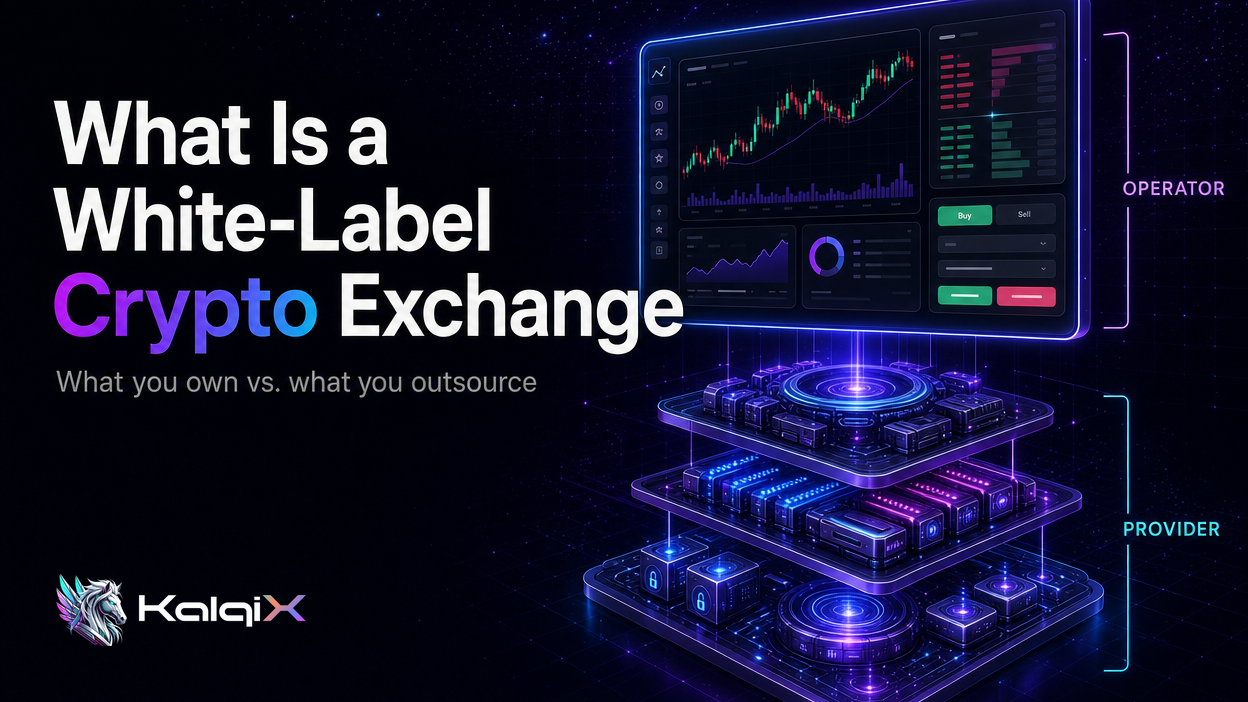
A trader opens an exchange, sees its logo, chooses a market and places an order. It looks like one product. Underneath, several different systems may be doing the work.
The team behind that brand does not necessarily build the matching engine, operate the settlement infrastructure or hold the trader’s funds. It may use a white-label provider for some or all of those functions.
That is the starting point for understanding what a white-label crypto exchange is: a trading product offered under your own brand, using infrastructure supplied by another company or protocol.
But the label alone tells you surprisingly little. The useful question is what stays yours, what gets outsourced, and what that division means for the people trading on your exchange.
What “white-label” actually means
White-label means one provider supplies a product or service that another business offers under its own branding.
In crypto, that can mean a nearly complete exchange platform with a configurable interface. It can also mean a narrower infrastructure layer, such as an order book that an existing DEX plugs into.
Think of a shop using a payments provider. The shop owns the customer relationship and decides what it sells. It does not need to build the network that processes each payment.
The same separation can apply to trading. Your exchange can own the user experience while another system handles matching and settlement.
White-label describes a commercial arrangement, not a security model. It does not automatically mean centralized, decentralized, custodial or self-custodial. Those properties depend on the infrastructure underneath.
What you own, and what you control
“Your own exchange” usually means your own market-facing product and business. It does not necessarily mean you own every line of software that runs it.
Legal ownership of code, designs and customer data depends on the agreement. Operational control depends on which parts the provider lets you configure.
Here is the practical split:
| Layer | What an exchange team typically controls | What a provider may supply |
|---|---|---|
| Brand | Name, identity, positioning and community | A customizable interface or frontend connection |
| Customer experience | User journeys, content and support | Trading components, APIs and platform tools |
| Business model | Commercial strategy and customer acquisition | Fee collection mechanisms or revenue-sharing arrangements |
| Markets | Decisions about which markets to offer, within supported capabilities | Order-book infrastructure and market support |
| Execution | Choice of infrastructure and available trading features | Matching engine and order-processing rules |
| Custody and settlement | Choice of architecture, not necessarily direct control of funds | Custody systems or smart contracts and settlement infrastructure |
The exact boundary varies. A provider offering a complete hosted platform is different from one supplying an execution layer.
That distinction matters because it determines both your freedom to build and your dependence on the provider.
The brand and customer experience stay with you
The visible part of an exchange is more than a logo.
It includes who the product serves, how people discover it, how clearly it explains trading, and what happens when a user needs help. Those are product and business decisions, not matching-engine decisions.
An exchange aimed at experienced traders might emphasize order entry and API access. A community-focused product might emphasize a simpler interface and educational content.
Both could use the same underlying execution infrastructure while offering very different experiences.
Outsourcing infrastructure does not outsource responsibility for communicating honestly. Your users still need to understand where their funds sit, which fees apply and what happens when a withdrawal is delayed.
They may never know the engine provider’s name. They will know yours.
What the matching engine does
A central limit order book, or CLOB, collects buy and sell orders at prices traders choose. The matching engine determines which orders trade against each other.
Under price-time priority, the best price gets filled first. Orders at the same price are ranked by when they arrived.
For example, suppose two sellers offer ETH at the same price. If one order arrived earlier, it should receive the next eligible fill before the later order. Our price-time priority explainer walks through that queue in more detail.
A provider supplying this layer handles a demanding technical job: maintaining the book, processing orders and applying the matching rules consistently.
The exchange owner still needs to understand those rules. A polished interface cannot compensate for execution its users cannot trust.
Useful questions include:
- What determines which order gets filled first?
- Can anyone see an order before it matches?
- How is correct execution checked?
- What happens when the matching service becomes unavailable?
These questions tell you more than the phrase “institutional-grade engine.”
Custody and settlement are separate questions
Matching a trade and settling it are not the same thing.
Matching determines that a buyer and seller have traded. Settlement records the resulting changes to their balances.
Custody asks a different question: who controls the funds?
A custodial white-label platform may use infrastructure in which an operator controls customer assets. A self-custodial model can instead keep funds in smart contracts, with withdrawals governed by the system’s rules rather than an operator’s permission.
Neither arrangement follows automatically from having your own brand.
On KalqiX, funds sit in the KalqiX contract on Base, not with an operator. An on-chain escape hatch lets users withdraw directly even if every other component goes offline.
That does not mean funds remain untouched in a wallet throughout trading. It means the operator does not take custody of them, and users have a withdrawal path independent of the normal app.
For prospective exchange owners, this is a foundational choice. It affects the product’s trust assumptions, not just its technical specification.
Infrastructure is not the same as liquidity
An order book is a system for organizing orders. Liquidity is the actual buying and selling interest available in that system.
You can have a functioning exchange engine and still have a thin market.
That distinction often gets lost in white-label discussions. Access to trading software does not, by itself, guarantee narrow spreads or enough depth for large orders.
A useful provider conversation separates three things:
- Engine capacity: how much activity the system can process.
- Available liquidity: the orders traders can actually execute against.
- Liquidity structure: whether your product has its own isolated book or connects to a shared one.
KalqiX uses a shared order book across partner frontends. Each partner adds to the same book rather than splitting liquidity into a separate venue.
That structure helps avoid fragmentation. It does not guarantee a particular spread, fill price or level of depth. Market orders can still slip when available liquidity is thin.
How KalqiX divides the work
KalqiX is exchange infrastructure, not just an exchange. Its mission is to power the next 1,000 exchanges, while also running its own trading app.
A project can keep its brand, frontend, community and token, then plug into KalqiX’s ZK-powered order book for matching and settlement. Partners earn a negotiated share of trading fees.
The infrastructure handles several distinct jobs:
- Order protection. Orders are encrypted before leaving the user’s device and do not enter a public mempool. Their contents are private before matching.
- Matching. A Rust engine matches orders by price-time priority.
- Execution verification. Each batch of trades receives a zero-knowledge proof built with Succinct’s SP1. The proof demonstrates that matching followed the rules without front-running or reordering.
- Settlement and data availability. A smart contract verifies the proofs on Base, where trades settle. Trade data is published to Avail DA so anyone can independently rebuild the state.
Matching happens first; proofs follow. And privacy has a specific boundary: after matching, trades are public on the explorer.
For an exchange owner, this means the execution layer comes with defined rules and verification mechanisms. It is not an engine you can quietly instruct to favor selected customers.
White-label does not always mean launching a new exchange
An existing trading product can use external execution infrastructure without replacing its whole business.
QuickSwap is an example. Since July 2026, it has offered access to KalqiX’s order book through Avail Atomic.
For each trade, QuickSwap checks whether the order book offers a better price than its AMM pools. If it does, the trade routes to the book and either fills completely or does not happen. Otherwise, the AMM handles it as usual.
Users stay in the same app, with no bridge or custody handoff.
This is a narrower integration than launching an entirely new branded exchange. The important idea is the same: the product users recognize and the infrastructure executing their trades do not have to be built by the same team.
Our QuickSwap integration explainer covers that separation in more detail.
What you do not outsource
Using a provider reduces the infrastructure you need to build. It does not remove the work of running a credible trading product.
You still need a reason for users to choose you. You still need clear support, accurate disclosures and a sustainable business model.
You also need to assess your legal and regulatory obligations. A provider’s software, self-custody architecture or commercial agreement is not a blanket exemption from those obligations.
And supported features remain a real constraint. You cannot offer a product simply because it fits your branding plans. KalqiX currently supports spot trading; perpetual futures are in development and are not live.
The right mental model is outsourcing a defined technical layer, not outsourcing your entire responsibility to customers.
FAQ
Does a white-label crypto exchange hold users’ funds?
It depends on the custody architecture. White-label platforms can be custodial or self-custodial, so check who controls assets and whether users can withdraw without the operator.
Does white-label exchange software include liquidity?
Not necessarily. A provider may supply software, access to a shared book or separate liquidity arrangements, and those are different things.
Can a DEX use white-label infrastructure?
Yes. A DEX can integrate an execution layer while keeping its existing frontend and other trading infrastructure, as QuickSwap does with KalqiX.
The takeaway
A white-label crypto exchange separates the business users see from some of the infrastructure running it.
Your brand, customer experience and commercial decisions can stay yours. Matching, verification and settlement can come from a provider. What matters is knowing exactly where that boundary sits, especially for custody and liquidity.
Want to launch your own exchange on KalqiX? Get in touch.