
Why KalqiX Runs a Trading App Alongside Its Exchange Infrastructure
KalqiX has its own trading app, but its mission is to power the next 1,000 exchanges. Here is how those roles fit together, and what partners keep when they build on its execution layer.

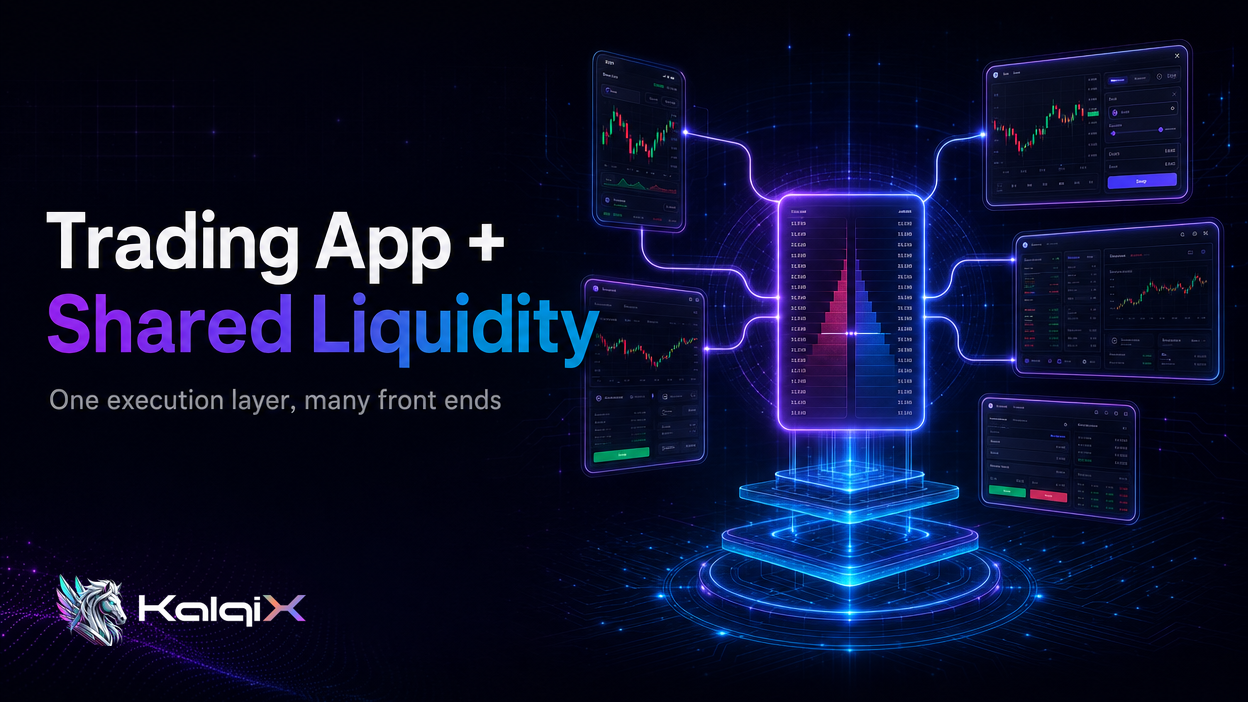
Visit KalqiX and you can trade. Read about KalqiX and you will see a different emphasis: infrastructure built to power the next 1,000 exchanges.
For a team considering a white-label integration, that raises a reasonable question. If KalqiX wants to power our exchange, why does it also run one of its own?
The answer starts with separating the interface from the execution layer. The KalqiX app is one place to access the infrastructure. It is not the limit of what that infrastructure is built to serve.
Here is how the two roles fit together, what partner exchanges keep, and what they use KalqiX to handle.
Two roles, not two different products underneath
KalqiX operates exchange infrastructure and its own trading app.
The infrastructure is a ZK-powered central limit order book, or CLOB. Buyers and sellers submit orders, and a matching engine pairs them by price, then time. Zero-knowledge proofs verify that the engine followed those rules before trades settle on Base.
The app is a trader-facing interface to that infrastructure. It gives users somewhere to connect a wallet, deposit, place orders and withdraw.
A partner-branded exchange provides another interface. The partner keeps its own brand and frontend while using KalqiX for matching and settlement.
| Layer | What it does | Who provides it |
|---|---|---|
| Brand and frontend | Gives users an interface and a product identity | KalqiX for its app, each partner for its own |
| Shared order book | Brings buy and sell orders together | KalqiX |
| Matching and execution proofs | Matches orders and proves price-time priority was followed | KalqiX, using Succinct’s SP1 for proofs |
| Settlement | Verifies proofs and settles trades | KalqiX smart contracts on Base |
| Data availability | Publishes trade data so anyone can rebuild the state | Avail DA |
The app is an access point. The execution layer is the shared infrastructure.
That distinction matters because a frontend does not need to own a matching engine to offer order-book trading.
What the KalqiX app makes concrete
Infrastructure can sound abstract until someone uses it.
The KalqiX app makes the execution layer accessible as a working trading product. A trader can place a limit order, see a fill and follow the resulting trade on the explorer. A builder can look at an actual interface rather than trying to understand the system entirely through architecture diagrams.
That does not mean partners must reproduce the KalqiX app. It means the underlying capabilities are available to inspect and use.
KalqiX mainnet launched on Base on 6 May 2026 with spot trading. As of 29 September 2026, the markets were cbBTC/USDC and ETH/USDC. The app supports limit and market orders, with good-till-cancelled, immediate-or-cancel and fill-or-kill instructions.
Those instructions control what happens to an order. An immediate-or-cancel order fills whatever it can immediately and cancels the rest. A fill-or-kill order must fill completely immediately or not execute.
For technical teams, the KalqiX docs provide the REST API. Algo traders can also use the official Hummingbot connector.
What partners keep, and what they plug into
A white-label exchange is not simply a KalqiX page with a different logo.
The model lets an exchange, DEX or project retain its own brand, frontend, community and token while plugging into KalqiX’s order book. Partners earn a negotiated share of trading fees.
The division is straightforward:
- The partner keeps the user-facing product. Its identity and frontend remain its own.
- KalqiX supplies the execution layer. Partners use the shared order book, matching and verifiable settlement rather than building those components themselves.
- The commercial arrangement is negotiated. Fee sharing is part of the partnership, not a universal percentage.
- Partner pricing can differ. The fee schedule on the KalqiX app should not be treated as the fee schedule for every partner app.
Our guide to what a white-label crypto exchange owns and outsources explains this separation in more detail.
For a prospective partner, the useful question is not whether KalqiX also has a frontend. It is whether the infrastructure lets your team deliver the product it wants without taking on the work of building a matching and settlement system.
Different frontends do not have to mean separate liquidity
An exchange interface and an order book are not the same thing.
If every new branded exchange starts with an isolated book, each has to attract buyers, sellers and market makers independently. A good interface does not solve an empty market.
KalqiX’s model works differently. Partner frontends add orders to one shared order book, pooling liquidity instead of splitting it across separate branded venues.
Think of several doors into the same marketplace. The doors can look different and serve different communities. The buyers and sellers inside do not have to be separated according to which door they used.
This is why the KalqiX app and partner-branded exchanges can coexist within the same infrastructure strategy. A new frontend does not necessarily mean another disconnected pool of orders.
Shared liquidity is not a guarantee of deep markets or perfect fills, however. Execution still depends on available orders, spreads and trade size. A market order can slip when the book is thin, regardless of which interface submitted it.
The structural benefit is narrower and more useful: partners do not need to fragment the book merely to retain their own identity.
The execution guarantees sit below the brand
A trader should not have to rely on a frontend’s branding to know how orders are handled.
KalqiX’s execution layer addresses three separate questions: who can see an order before matching, whether matching follows the rules, and where funds are held.
Order privacy before matching
Orders are encrypted before they leave the trader’s device, and there is no public mempool. Pending orders are not broadcast for bots to inspect and front-run or sandwich.
This is pre-trade privacy, not permanent transaction secrecy. After matching, trades are public on the explorer.
Verifiable matching
The Rust matching engine uses price-time priority: better prices come first, then earlier orders at the same price. It delivers sub-10 millisecond matching and supports 250,000+ transactions per second.
Every batch of trades is proven using Succinct’s SP1. The proof shows that matching followed price-time priority and that orders were not front-run or reordered. A smart contract verifies the proof on Base.
Matching and proof generation are distinct stages. Trades match instantly; proofs follow. Fast fill confirmation should not be confused with completed on-chain settlement.
Self-custody and recoverability
Funds sit in the KalqiX contract on Base, not with an operator. An escape hatch lets users withdraw directly on-chain even if every other component goes offline.
Trade data is published to Avail DA so anyone can independently rebuild the full state.
These are properties of the execution infrastructure. They are not features that each partner must recreate in its frontend.
QuickSwap shows why infrastructure is broader than an app
Not every integration needs to look like a standalone order-book exchange.
QuickSwap was the first DEX live on KalqiX’s layer, beginning in July 2026. Its integration adds order-book execution to an existing AMM experience.
For each trade, QuickSwap checks whether KalqiX’s order book offers a better price than its AMM pools. If it does, the trade routes to the order book through Avail Atomic and either fills completely or does not happen. Otherwise, the AMM handles the trade as usual.
The user stays in the same app, without bridging or handing off custody.
That is a different presentation from opening the KalqiX app and placing a limit order. Yet both use KalqiX’s execution infrastructure.
Our walkthrough of how QuickSwap adds a trustless CLOB explains the integration. The positioning lesson is simple: KalqiX can improve another DEX without replacing that DEX’s identity or asking its users to move to our app.
What prospective partners should evaluate
The existence of the KalqiX app is worth understanding. But it should lead to practical questions, not assumptions about how every integration must work.
Before choosing an execution partner, clarify:
- Your product model. Are you launching a branded exchange or adding order-book execution to an existing DEX?
- Your frontend requirements. Which trading workflows matter to your users, and what will your team build?
- Live market coverage. Do the available markets support your intended product? Confirm current availability through official channels.
- Integration and operations. Review the API, settlement flow and withdrawal process, including what happens when components are unavailable.
- Commercial terms. Agree on fee sharing and partner-app pricing rather than assuming the KalqiX app’s terms apply.
These questions separate the shared execution system from the product and business each partner wants to build.
One app, an infrastructure mission
KalqiX runs a trading app so traders can access its execution layer directly. It supplies exchange infrastructure so other teams can offer access under their own brands and frontends.
Those roles fit together because the frontend is not the order book. Multiple products can use one execution layer without becoming the same product.
The mission remains to power the next 1,000 exchanges, not to make every trading experience look like KalqiX.
Want to launch your own exchange or add order-book execution? Get in touch with KalqiX.