
Who Owns the Customer Relationship on a White-Label Crypto Exchange?
Plugging into shared exchange infrastructure doesn't mean sharing your business. Here's what partners on KalqiX keep, what they outsource, and why earning users' trust is still their job.

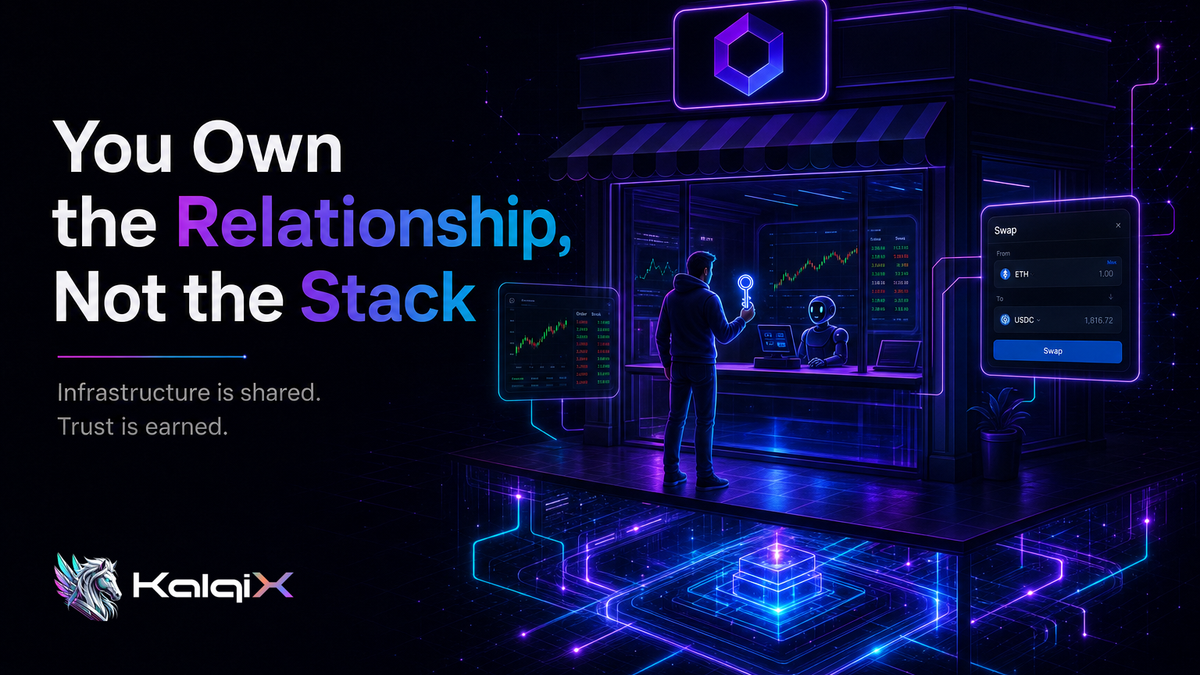
Every team evaluating exchange infrastructure eventually asks the same uncomfortable question: if we build on someone else's engine, whose customers are these?
It's the right question. Outsourcing your matching engine is a technical decision. Outsourcing your customer relationship is a business decision, and a much bigger one. The two often get blurred together in sales pitches, which is how teams end up with a "white-label" exchange that feels more like a reseller arrangement.
This post separates them. We'll walk through what a partner building on KalqiX actually owns, what it hands off, who holds the money, and why plugging into a shared execution layer still leaves the partner responsible for earning every user's trust.
Two things that sound alike but aren't
A shared execution layer is infrastructure. It matches orders, settles trades and keeps the books correct. Users rarely see it, the same way most people paying online never think about the payment processor underneath.
A shared customer-facing business is something else. It means the provider sets the experience, controls the brand, owns the user accounts and decides how the product evolves. The "partner" is mostly a logo on top.
KalqiX is built to be the first and not the second. Our mission is to power the next 1,000 exchanges, the way Stripe powers payments or AWS powers apps. A partner keeps its own brand, frontend, community and token, and plugs into KalqiX's ZK-powered central limit order book (CLOB) for matching and settlement. If you're new to the model, our guide to what a white-label crypto exchange is covers the basics.
The three-way split: partner, KalqiX and the user
The cleanest way to answer "who owns the customer relationship?" is to notice there are three parties, not two.
| Who | What they own or control |
|---|---|
| The partner | Brand, frontend, community, token, user experience, fees charged on its app, support, education and communication |
| KalqiX | The matching engine, ZK proofs of each batch, settlement on Base, publishing trade data to Avail DA |
| The user | Their funds, their wallet and their keys |
That last row is the one most white-label discussions skip. On a custodial white-label setup, the provider or the operator often holds user deposits. Whoever holds the money holds a lot of leverage over the relationship, and a lot of risk.
On KalqiX, funds sit in the KalqiX contract on Base, not with an operator. Withdrawals always go back to the user's own wallet. And an escape hatch lets users withdraw directly on-chain even if every other component goes offline. So neither the partner nor KalqiX "owns" the customer's assets. The user does.
That changes the nature of the relationship. A partner can't keep users by holding their funds hostage. It keeps them by being the place they want to trade.
What the partner keeps
The brand and the frontend
Users open the partner's app, see the partner's name and use the partner's interface. The order book underneath is KalqiX's, but the product is theirs. QuickSwap is the clearest live example: since July 2026, QuickSwap users can get order-book execution through KalqiX via Avail Atomic. Same app, no bridge, no custody handoff. For each trade, QuickSwap checks whether KalqiX's order book offers a better price than its AMM pools, and routes accordingly. Its users keep trading on QuickSwap. We covered the mechanics in how KalqiX lets any DEX add a trustless CLOB.
The community and the token
A partner's community, governance and token remain its own. KalqiX doesn't ask a project to fold its identity into ours. For DAOs and token communities, this is often the whole point: an exchange becomes a product the community owns, not one it rents. We explored that case in community-owned crypto exchanges.
The economics
Partners earn a negotiated share of the trading fees, and partner apps can charge differently from the KalqiX app. That means pricing is part of the partner's own strategy, not a number dictated to it.
What the partner outsources
Here is what a partner doesn't have to build or operate:
- A matching engine. KalqiX's engine is written in Rust and matches by price-time priority, like the NYSE and NASDAQ, with sub-10 millisecond matching and 250,000+ transactions per second.
- MEV protection. Orders are encrypted before they leave the user's device and there's no public mempool, so nobody sees an order before it's matched. That's what stops front-running and sandwich attacks.
- Proof of correct execution. Every batch of trades is proven with a zero-knowledge proof built with Succinct's SP1, showing orders were matched by price-time priority and nothing was reordered. A smart contract on Base verifies the proofs.
- Data availability. Trade data is published to Avail DA, so anyone can rebuild the full state independently.
- Liquidity from zero. Every partner's frontend adds to one shared order book, so liquidity is pooled instead of split across dozens of thin venues.
That last point deserves a moment. Shared liquidity is where shared infrastructure creates value that no single partner could create alone. A trader on one partner's frontend can be matched against an order placed through another's. Each partner benefits from the others' activity, without anyone giving up their users.
Why outsourcing execution doesn't outsource trust
This is the part teams sometimes underestimate.
When something confuses a user, they don't open a ticket with the infrastructure provider. They message the brand they see. If a withdrawal feels slow, if a fill looks odd, if a scam account impersonates the app, the partner hears about it first. The customer relationship comes with the responsibility.
The good news is that a partner on KalqiX doesn't have to answer with "trust us." It can answer with evidence. But it still has to do the answering. In practice, earning trust comes down to a handful of jobs.
1. Explain the product honestly
Users deserve a clear picture of what they're getting. That includes the limits. On KalqiX, what's private is your order before it's matched. After matching, trades are public on the explorer, like any on-chain venue. A partner that markets "fully private trading" would be overselling, and users notice when claims don't match reality.
2. Make the flows feel normal
Self-custody comes with a few steps that are new to people arriving from centralized exchanges. Deposits from Base happen in two steps (approve, then deposit), and users need a little ETH on Base for gas. Withdrawals happen in two steps too: request in the app, then claim on Base when the proof is ready. Partners who explain these steps up front turn potential support tickets into confident users.
3. Point to verifiable sources
Instead of asking users to take execution quality on faith, partners can point them to tools anyone can check:
- The KalqiX explorer for matched trades
- The status page at status.kalqix.com
- The Hexens audit of KalqiX's smart contracts (9 findings, zero critical, zero high, all medium findings fixed)
- ZK proofs verified on Base, and trade data on Avail DA
"Don't trust, verify" only works if someone tells users where to look. That someone is usually the partner.
4. Protect the front door
The frontend is the partner's. So is its domain, its social accounts and its community channels. Phishing sites and fake support accounts target whatever brand users recognise. Partners should repeat the basics often: never share a seed phrase or private key with anyone, including people who DM offering help, and check old token approvals with a tool like revoke.cash. It also helps to be explicit that no KalqiX token or airdrop has been announced, so anyone offering one is running a scam.
5. Communicate when it matters
Markets move fast and users get anxious. Clear, timely updates from the brand they know do more for trust than any architecture diagram. The infrastructure can be verifiable, but the voice users listen to belongs to the partner.
What about KalqiX's own app?
A fair question from any partner: if KalqiX runs its own trading app, are we competing for the same users?
KalqiX sells to exchanges and projects first, and runs its own app alongside. Because every frontend, ours included, feeds the same order book, activity on the KalqiX app adds liquidity that partners' users trade against. The app also gives us direct experience of what traders need, which feeds back into the infrastructure partners use. We explained the reasoning in more depth in why KalqiX runs a trading app alongside its exchange infrastructure.
FAQ
Does a white-label crypto exchange own its customers?
On KalqiX, the partner owns the brand, frontend, community and user experience, which is the customer relationship in every practical sense. The user owns their funds, which stay in their own control through the KalqiX contract on Base.
Who holds user funds on a KalqiX-powered exchange?
Neither the partner nor an operator. Funds sit in the KalqiX contract on Base, withdrawals always return to the user's own wallet, and an escape hatch allows direct on-chain withdrawal even if every other component goes offline.
Can a partner set its own trading fees?
Yes. Partner apps can charge differently from the KalqiX app, and partners earn a negotiated share of the trading fees.
Do partners share liquidity with each other?
Yes. Every partner's frontend adds to one shared order book, so liquidity is pooled rather than split across separate venues.
The takeaway
A shared execution layer and a shared business are not the same thing. On KalqiX, partners outsource the hardest infrastructure (matching, MEV protection, ZK-verified settlement and data availability) while keeping the brand, the frontend, the community and the economics. Users keep their own funds.
What partners can't outsource is the relationship itself. The infrastructure gives them proof instead of promises. Turning that proof into trust is still their work, and it's the work that builds a real exchange.
If you want to launch your own exchange on KalqiX, get in touch through kalqix.com.